VoS NEWS DESK | SCIENCE & TECHNOLOGY | 26 OCTOBER 2026
Infrared cameras detect heat patterns rather than relying on visible light. They are widely used in industrial inspections, medical research, building assessments, search-and-rescue operations and security systems. Objects that cannot easily be seen in darkness may still be detected because their temperatures differ from their surroundings.
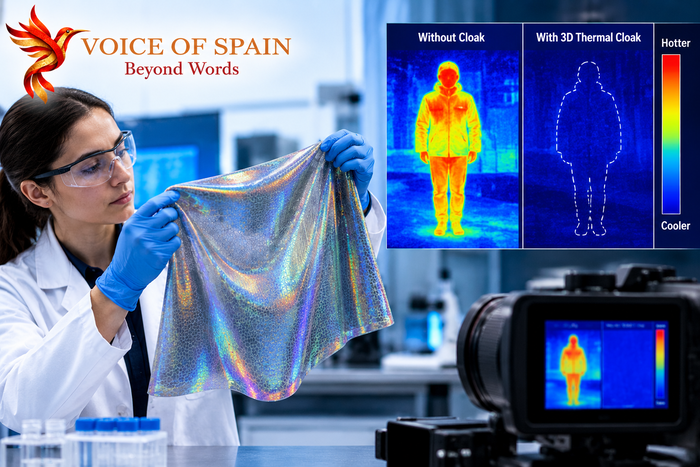
The newly developed cloak addresses this challenge by redirecting heat around a protected region. Rather than simply blocking heat from reaching an object, the structure guides thermal energy through carefully designed pathways, helping maintain the temperature pattern outside the cloak. As a result, an infrared camera can record a scene that resembles the one it would see if the concealed object were not there.
The researchers say the device represents an important step beyond earlier thermal-cloaking experiments, which were generally restricted to flat, two-dimensional arrangements or worked only when heat moved in a particular direction. The new structure was designed to operate in three dimensions and accommodate complicated shapes.
The research team used a combination of advanced manufacturing and material engineering to construct the cloak. A complex aluminium lattice was produced using three-dimensional metal printing. The remaining spaces were filled with a rubber-like material that conducts heat relatively poorly.
These two materials perform different but complementary functions. The aluminium provides routes through which heat can travel efficiently, while the surrounding material helps restrict and control heat flow. By carefully designing the structure, researchers can adjust how heat moves in different directions and around the protected area.
The team tested the completed device by placing it between hot and cold regions, creating a temperature difference that caused heat to flow through the surrounding environment. Infrared imaging was then used to observe the temperature distribution.
According to the reported experiments, the cloak redirected heat around the hidden region while preserving a temperature pattern that made the object difficult to distinguish through thermal imaging. The researchers also tested complicated three-dimensional geometries, demonstrating that the concept was not limited to simple shapes.
One of the most promising applications could be the protection of electronic equipment. Modern computers, data centres and other advanced systems generate substantial heat, and managing that heat is essential for maintaining performance and preventing damage. A material capable of controlling heat flow in several directions could help engineers develop improved thermal-management systems and protect sensitive components from extreme temperatures.
The technology may also have applications in equipment that operates in demanding environments, where temperature differences can affect reliability. Carefully directing heat could help create protective layers for devices exposed to extreme conditions, although practical applications will depend on further testing, cost and manufacturing requirements.
Researchers have also identified potential uses in thermal concealment and security. In principle, a material that alters an object's thermal signature could make some equipment less visible to infrared detection systems. However, the current demonstration should not be confused with a universal invisibility device: it concerns thermal imaging under the tested conditions, not invisibility to the human eye or to every type of sensor.
Despite the breakthrough, important challenges remain. One major objective is to develop cloaks that can also conceal objects that generate their own heat. The current approach focuses on controlling heat flowing through the surrounding environment; concealing a heat-producing object would require more advanced control over the energy generated inside the protected region.
Researchers will also need to establish how the technology performs under changing temperatures, real-world environmental conditions and prolonged use. Manufacturing larger structures and adapting them to specific industrial applications may require further engineering.
The findings, published in Nature Communications, demonstrate how carefully designed materials can manipulate heat in ways that were previously difficult to achieve experimentally. While commercial uses are not immediate, the research provides a potential foundation for future advances in thermal engineering, electronics protection and infrared technology.
VoS STRATEGIC INSIGHT
The significance of this discovery extends beyond the idea of invisibility. Heat is a critical factor in computing, manufacturing, energy systems and advanced electronics. If thermal cloaking can eventually be adapted for practical industrial use, it could help engineers protect sensitive equipment, control heat more precisely and design materials with capabilities that conventional structures cannot provide.
For the technology to move from laboratory demonstrations into everyday use, researchers will need to demonstrate reliable performance, affordable production and effective operation in complex environments. Its long-term value will depend not only on its ability to alter thermal images, but also on whether the same principles can solve real engineering problems.
Source: University of Illinois Urbana-Champaign News Bureau, via ScienceDaily, 26 October 2026. Read the research report.