VoS NEWS DESK | INTERNATIONAL BUSINESS & AVIATION | 28 OCTOBER 2026
Boeing remains one of the world’s most important aircraft manufacturers, supplying commercial aeroplanes to airlines across international markets as well as military and aerospace equipment to government customers. Its production performance has consequences beyond the company itself, affecting airline fleet planning, aircraft delivery schedules, suppliers, workers and the wider aviation industry.
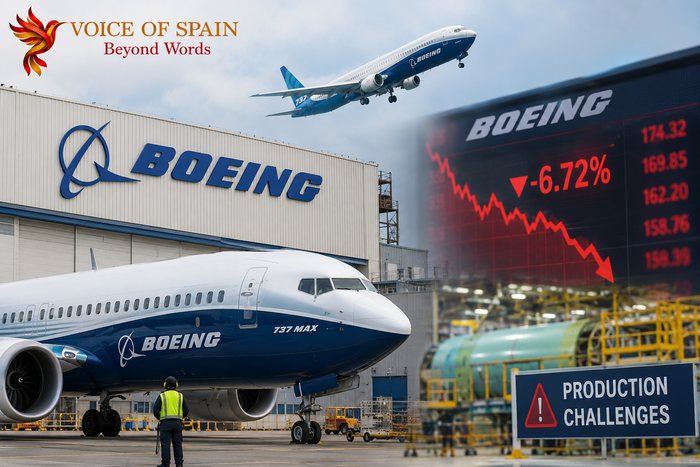
The company’s latest results have highlighted the difficulties involved in increasing production while maintaining quality and meeting delivery commitments. Boeing reported that it was behind schedule in stabilising output from its 737 programme at a target rate of 47 aircraft per month. It also reduced its full-year delivery expectations, indicating that it would deliver fewer than the 500 737 aircraft previously targeted. Deliveries of the 787 programme were expected to reach approximately 90 aircraft, at the lower end of its guidance.
The market reaction was immediate. Boeing shares fell by around 10 per cent in trading reported on 28 October, reaching an 18-month low. Investors had anticipated a stronger recovery following progress on certification for the 737 MAX 10, but the latest production outlook suggested that improvements would take longer than expected. Chief executive Kelly Ortberg indicated that the production ramp-up would extend into next year, disappointing investors seeking clearer evidence of a sustained turnaround.
Boeing’s third-quarter financial results offered a mixed picture. The company reported revenue of approximately $24.19 billion, up around 4 per cent from the same period a year earlier. However, it recorded a net loss of $116 million. Although that represented a substantial improvement on the loss reported in the third quarter of 2025, commercial aircraft operations continued to face cost pressures, including less favourable delivery patterns, higher projected costs associated with production adjustments and increased supply-chain expenses.
The company also reported positive developments that could support its longer-term recovery. Boeing said its total order backlog had grown to a record $745 billion, including more than 6,300 commercial aircraft. Its third-quarter commercial aircraft business recorded 300 net orders, including orders from Turkish Airlines, Ethiopian Airlines and Lufthansa. The scale of the backlog indicates continued demand for aircraft, but converting orders into completed deliveries remains a major operational challenge.
One of the most closely watched areas is the 737 programme, which is central to Boeing’s commercial aircraft business. Airlines rely on predictable deliveries to expand routes, replace older aircraft and manage fuel efficiency. Delays can force carriers to revise fleet plans, extend the use of existing aircraft or adjust capacity. For Boeing, failure to meet delivery targets can also affect revenue timing, customer relationships and investor confidence.
Production increases must be managed carefully because aircraft manufacturing involves complex supply chains, thousands of components and strict regulatory requirements. Increasing output too quickly can place pressure on suppliers and production systems, while slower output can create backlogs and financial uncertainty. Boeing must therefore balance the need to deliver more aircraft with the need to ensure that quality and safety standards are consistently met.
Certification progress is another important part of the recovery. Boeing announced that the 737-7 had received amended type certification from the US Federal Aviation Administration and that the 737-10 had achieved certification in October. These milestones represent progress for the programme, but certification does not automatically resolve production bottlenecks or guarantee that delivery targets will be met. The company still needs to demonstrate that it can manufacture aircraft at a stable rate while meeting regulatory and customer requirements.
The broader financial picture also matters. Boeing reported operating cash flow of approximately $1.5 billion in the third quarter and non-GAAP free cash flow of around $500 million in its company results. Nevertheless, the weaker delivery outlook has prompted concerns about the pace of its recovery and its longer-term cash-generation ambitions. Investors will be looking for evidence that management can improve manufacturing consistency, control costs and translate strong demand into reliable deliveries.
For airlines, the situation highlights the importance of maintaining flexibility in fleet planning. Carriers ordering new aircraft must consider possible changes in delivery schedules, while manufacturers and suppliers need to coordinate production commitments more closely. Any extended delay could have consequences for route expansion, aircraft availability and operating costs across the sector.
Boeing’s recovery will therefore depend on more than financial performance alone. Consistent production, strong supplier relationships, regulatory compliance and a renewed emphasis on quality will all be essential. The company’s large backlog provides a substantial commercial opportunity, but delivering on those orders remains the central test of its operational turnaround.
VoS STRATEGIC INSIGHT
Boeing’s latest setback illustrates the difference between strong market demand and the ability to fulfil that demand reliably. A large order backlog can support future revenue, but it cannot compensate indefinitely for production delays, rising costs or missed delivery commitments. The company’s long-term recovery will depend on disciplined manufacturing, effective supplier coordination, regulatory compliance and sustained attention to aircraft quality and safety. For the global aviation industry, Boeing’s performance will remain important because delivery reliability affects airlines, passengers, suppliers and employment across multiple countries.
Source: Boeing Investor Relations; Financial Times.