VoS NEWS DESK | INTERNATIONAL HEALTH & GLOBAL SECURITY | 27 OCTOBER 2026
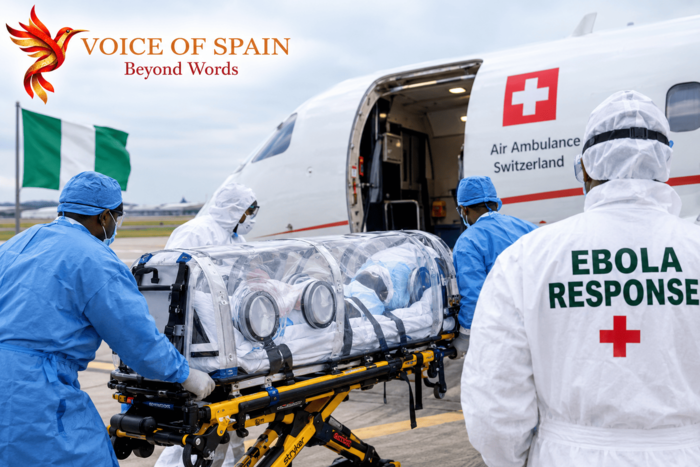
The evacuation marks an important development in Nigeria's response to the imported Ebola case. According to the Nigerian health minister, Muhammad Ali Pate, the patient was clinically stable, conscious and able to communicate before leaving the country. Her laboratory results had also improved significantly. However, officials emphasised that an improvement in her condition did not automatically mean that she was no longer infectious, making continued medical precautions essential.
Following the transfer, the patient arrived in Switzerland and was admitted to Geneva University Hospitals. Her husband was taken to University Hospital Zurich for isolation and monitoring. Swiss authorities confirmed their arrival and said the hospitals were equipped to provide the required care. They also stated that there was no risk to the Swiss public under the circumstances described by the authorities.
The case has attracted international attention because Ebola is a serious infectious disease that requires rapid identification, appropriate clinical care and carefully managed contact-tracing procedures. Although the patient was transferred across international borders, the evacuation was conducted through medical arrangements intended to protect healthcare personnel, passengers and the wider public.
Nigerian authorities have been monitoring people who had contact with the patient. Reports on Monday indicated that 52 contacts were being followed, while earlier information from the Nigeria Centre for Disease Control and Prevention identified 53 contacts linked to the case. These figures reflect reporting at different stages of the response; authorities have continued updating their records as investigations progress.
Contact-tracing is one of the principal measures used to control the spread of Ebola. Public health teams identify people who may have been exposed, assess the nature of their contact and monitor them for symptoms during the relevant observation period. Anyone who develops symptoms can then be assessed promptly, helping health authorities identify potential transmission before a wider chain of infections develops.
The investigation into the origin of the infection remains particularly important. Reports indicate that the patient had travelled to Uganda before returning to Nigeria, but officials have not established precisely where or how she contracted the virus. Investigators must examine the patient's travel history, possible exposure circumstances and relevant contacts before drawing conclusions about the source.
The case has also highlighted the importance of international cooperation during infectious disease emergencies. Nigeria's medical teams treated and stabilised the patient before the evacuation, while Swiss medical institutions assumed responsibility for her continuing treatment. The World Health Organisation has also been involved in the wider regional response to the outbreak. Such cooperation can help countries share expertise and coordinate care when patients require specialist treatment abroad.
Ebola outbreaks can place considerable pressure on healthcare systems, particularly where hospitals have limited specialist facilities, protective equipment or trained personnel. Effective responses depend on early detection, safe patient isolation, appropriate infection-prevention measures and clear communication between medical teams and public health authorities.
Healthcare workers are especially important to outbreak control because they may face exposure when caring for infected patients. Strict infection-control procedures, suitable protective equipment and careful handling of potentially infectious materials are therefore essential. Medical evacuation must also be coordinated to prevent unnecessary exposure during transport.
The virus identified in this outbreak belongs to the Bundibugyo species of Ebola virus, according to reports on the case. Different Ebola virus species can have distinct outbreak histories, and available vaccines or treatments cannot automatically be assumed to work against every species. Medical teams must therefore follow current specialist guidance when selecting treatment and implementing control measures.
The wider regional situation remains a concern. The World Health Organisation and national health authorities have been responding to Ebola infections in parts of Central and East Africa, with the current outbreak involving the Bundibugyo virus. Continued surveillance is important because people may travel between countries before symptoms become apparent, potentially creating challenges for early detection.
Nevertheless, the evacuation of the Nigerian patient should not be interpreted as evidence that Ebola is spreading uncontrollably within Switzerland. Swiss authorities have stated that the medical facilities involved are equipped to manage the case and that there is no risk to the public under the circumstances reported. Maintaining a clear distinction between a confirmed medical case and a wider community outbreak is important for accurate public understanding.
For Nigeria, the immediate priority is to complete the investigation, maintain contact monitoring and respond quickly to any additional suspected cases. Officials must also ensure that hospitals, laboratories and local health services have the information and resources required to identify possible infections.
Public communication will play a significant role in the response. Health authorities need to provide timely updates while discouraging rumours and unverified claims. People who may have been exposed should follow official medical advice rather than relying on social media speculation or attempting to assess their risk without professional guidance.
The case is also a reminder that infectious diseases can cross borders in an interconnected world. International travel, diplomatic activity and commercial links mean that health emergencies in one country may require coordinated responses elsewhere. Effective surveillance, strong healthcare systems and transparent cooperation remain essential to reducing these risks.
As the investigation continues, the most important indicators will be whether contact monitoring is completed without further infections, whether the patient continues to recover and whether investigators can establish the likely source of exposure. Until the relevant authorities provide further findings, the precise origin of the infection remains uncertain.
VoS STRATEGIC INSIGHT
Nigeria's Ebola case demonstrates why rapid medical treatment and coordinated public health measures are essential when a potentially serious infectious disease is identified.
The patient's evacuation to Switzerland provides access to continuing specialist care, while contact-tracing in Nigeria remains necessary to establish whether other people were exposed. These measures address different but complementary priorities: treating the individual patient and preventing possible further transmission.
The episode also illustrates the importance of international preparedness. Countries need reliable surveillance systems, trained medical personnel, appropriate isolation facilities and clear procedures for transferring patients safely across borders.
Equally important is accurate public communication. Ebola requires serious medical attention, but reporting should distinguish confirmed cases from suspected exposure and should not generate unnecessary public alarm. In this instance, Swiss authorities have stated that there is no risk to the public, while Nigerian officials continue their monitoring and investigation.
Ultimately, the success of the response will depend on sustained vigilance, cooperation between health agencies and the timely identification of any additional infections. The case reinforces the principle that effective outbreak control begins with evidence, transparency and coordinated action.
Source: Associated Press (AP), Swissinfo and Nigeria's Premium Times.