VoS NEWS DESK | INTERNATIONAL POLITICS | 26 OCTOBER 2026
The election represents one of the most consequential political developments in Serbia in recent years. Vučić, who served as prime minister before becoming president, has remained a central figure in national politics since 2014. His government and political allies faced mounting criticism as demonstrations spread across the country, with students and other citizens demanding accountability, transparency and changes to the political system.
According to Vučić’s announcement based on preliminary results, the Student List was expected to secure between 135 and 140 seats in Serbia’s 250-seat parliament, while his Serbian Progressive Party was projected to win approximately 105 seats. Although final official results remained pending at the time of the concession, the preliminary figures indicated a decisive breakthrough for the student-backed movement.
The opposition’s success follows a period of sustained public mobilisation that began after a railway station canopy collapsed in Novi Sad in November 2024, killing 16 people. The tragedy prompted widespread anger and demands for accountability, with demonstrators questioning public safety standards, government transparency and the management of major infrastructure projects.
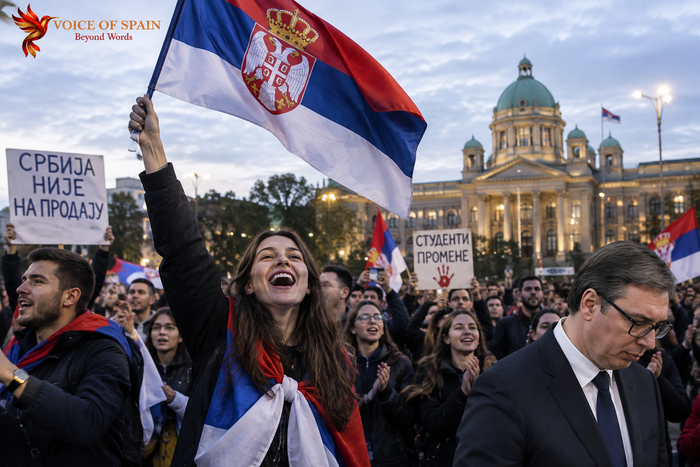
What began as student protests developed into a broader movement attracting support from citizens concerned about corruption, institutional independence and the future direction of Serbian democracy. Demonstrators organised rallies and public gatherings, while university students became increasingly prominent in calls for political responsibility and meaningful change.
The movement’s transition from street protests to electoral participation has been particularly significant. Rather than limiting its efforts to demonstrations, the student-backed opposition sought to convert public dissatisfaction into parliamentary representation. Its victory suggests that the campaign succeeded in attracting support beyond university campuses and mobilising a wider section of the electorate.
Voter participation was another notable feature of the election. Turnout approached 70 per cent, the highest reported level since the break-up of Yugoslavia in 1992. The strong participation reflected the importance many citizens attached to the contest and the possibility of a substantial change in political leadership.
Following Vučić’s concession, celebrations erupted in Belgrade, where supporters gathered in the streets to mark what they viewed as a historic victory. The outcome generated attention across Europe because Serbia occupies an important position between the European Union, Russia and other regional powers.
The result also raises questions about the future of Serbia’s political institutions. The new parliamentary balance could create opportunities to strengthen accountability, improve transparency in public administration and examine allegations of corruption. However, winning seats is only the beginning of a complex process that will require the opposition to develop a workable governing programme and build effective institutions.
The Student List now faces the challenge of turning a diverse movement into a functioning political force. Student-led campaigns can unite people around shared demands for reform, but governing requires decisions on economic policy, public spending, employment, education, healthcare and international relations. Maintaining unity among different groups will be essential as the movement moves from opposition campaigning to parliamentary responsibility.
Relations with the European Union are likely to be a major issue. Serbia has long pursued closer ties with the EU while maintaining important political and economic relationships with Russia and China. A change in parliamentary leadership could prompt renewed debate over the country’s European future, democratic standards and the reforms required for further integration.
The outcome also carries implications for Serbia’s relationship with Russia. Vučić’s government maintained close links with Moscow while also engaging with European institutions. A new political balance could lead to changes in the tone and priorities of Serbian foreign policy, although the precise direction of any future government remains uncertain.
Economic concerns will also influence the next phase. Citizens expect political change to produce improvements in living standards, employment opportunities and the quality of public services. A new administration would need to address these expectations while managing public finances and maintaining confidence among businesses and international partners.
The future of anti-corruption measures will be especially important. Protesters have repeatedly called for greater accountability and stronger institutions. Delivering credible reforms may require transparent investigations, stronger oversight of public contracts and safeguards to ensure that law enforcement and judicial bodies operate independently.
At the same time, political change can create uncertainty. Existing officials, administrative structures and established political networks do not disappear immediately after an election. Any incoming parliamentary majority will need to work through legal procedures, establish its leadership arrangements and demonstrate that it can govern effectively.
Serbia’s political transition will therefore be judged not only by the defeat of the ruling political camp but also by the conduct of the new parliamentary majority. Respect for democratic procedures, protection of civil liberties and constructive engagement with citizens will be important tests of its credibility.
The election has nevertheless demonstrated the potential influence of sustained civic participation. A movement that emerged from public anger over a deadly infrastructure disaster has become a central force in national politics, illustrating how demands for accountability can reshape the political landscape when they gain broad public support.
The coming weeks will be crucial as preliminary results give way to the formal electoral process and discussions begin over the composition and direction of the new parliament. Serbia’s future political course will depend on whether the Student List can convert its electoral success into stable leadership and meaningful institutional reform.
VoS STRATEGIC INSIGHT
Serbia’s election highlights the potential for civic movements to transform public dissatisfaction into electoral change. The student-led campaign gained momentum by connecting demands for accountability with broader concerns about corruption, public safety and democratic governance.
However, a decisive electoral victory does not automatically guarantee successful reform. The new political leadership will need to establish clear priorities, maintain unity and demonstrate that public institutions can operate transparently and independently.
The country’s international position will also require careful management. Serbia must navigate relationships with the European Union, Russia and China while addressing domestic expectations for political accountability and economic stability. Foreign policy decisions will therefore be closely linked to the credibility and priorities of the incoming parliamentary leadership.
The broader lesson is that democratic change is measured not only by the removal of an established political force but also by what follows. If the new majority strengthens institutional accountability, protects civil liberties and delivers practical improvements, the election could become a lasting turning point. If expectations are not met, public confidence may quickly weaken.
Source: Reuters