VoS NEWS DESK | INTERNATIONAL SPORTS | 23 October 2026
The Asian Para Games bring together athletes with disabilities from across Asia to compete in a wide range of sporting disciplines. The 2026 edition is being held in Japan's Aichi Prefecture, with Nagoya serving as a principal host city. The competition features thousands of athletes and officials across 18 sports, providing an international platform for para-athletes to demonstrate their skills, determination and competitive achievements.
However, the three anthem errors have drawn attention away from the sporting performances and towards the organisation of the event. National anthems are an important part of international sporting ceremonies because they represent the identity of participating nations and are traditionally played when athletes win gold medals. Playing the wrong anthem can therefore cause embarrassment for the athletes concerned and their delegations, while also creating diplomatic sensitivities.
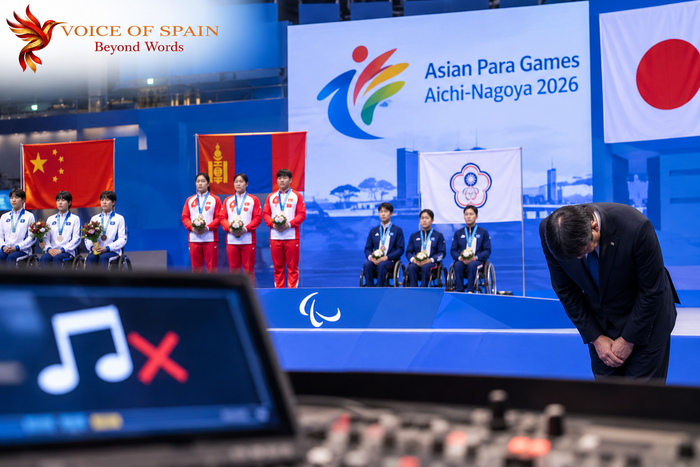
According to reports from Japanese officials and international news organisations, two of the mistakes occurred during para-taekwondo medal ceremonies on Monday, 19 October. The Iranian national anthem was mistakenly played when athletes from Chinese Taipei and Mongolia were receiving recognition for their gold-medal victories in men's and women's events respectively. The errors were particularly noticeable because the ceremonies were intended to honour the achievements of athletes representing different delegations.
During the women's para-taekwondo medal ceremony, organisers stopped the Iranian anthem after the Mongolian delegation pointed out the mistake. The correct Mongolian anthem was then played, using music provided by the delegation. In the men's event, the Iranian anthem was played in place of the anthem intended for the gold medallist from Chinese Taipei. Organisers subsequently arranged for the men's medal ceremony to be held again on Wednesday, 21 October, to address the error.
A separate incident occurred during a sitting volleyball fixture involving China and Iran. Before the women's match, the South Korean national anthem was played instead of China's anthem. The incorrect music continued for several seconds before officials recognised the problem and stopped it. The correct Chinese anthem was then played.
Although the mistakes were attributed to a technical setting in the music playback software, the repetition of similar errors has raised questions about the checks carried out before ceremonies and matches. International sporting events typically involve detailed protocols covering national flags, anthems, medal presentations, athlete introductions and other official procedures. These arrangements require accurate records, reliable equipment and coordination between technical staff and event officials.
Nagoya Mayor Ichiro Hirosawa, who is also acting as head of the Asian Para Games organising committee, apologised publicly for the incidents. He acknowledged that the recurrence of such errors was unacceptable, particularly because organisers had already faced criticism over similar problems during the Asian Games held earlier in the same region. His apology reflected the organisers' recognition that the mistakes had affected the athletes and delegations concerned.
The latest incidents have renewed scrutiny of preparations for major sporting competitions in Japan. The preceding Asian Games, which concluded on 4 October, faced criticism over several organisational shortcomings, including problems involving accommodation and ceremonial procedures. One earlier incident involved the North Korean national anthem being played instead of South Korea's anthem before a men's hockey match on 18 September.
The recurrence of anthem errors at the Para Games has therefore raised concerns about whether lessons from the earlier competition were adequately applied. When similar problems occur at consecutive events in the same host region, organisers face greater pressure to demonstrate that corrective measures are effective rather than merely promising improvements.
The issue also illustrates the importance of recognising the significance of national symbols in international sport. Athletes train for years to reach the podium, and medal ceremonies are among the most memorable moments of their careers. The correct presentation of national anthems is a fundamental part of acknowledging their achievements and showing respect for their countries or sporting delegations.
For para-athletes, the importance of well-organised competitions extends beyond ceremonial arrangements. Sporting events must provide accessible facilities, dependable scheduling, appropriate competition equipment and equal treatment for all participants. Organisational errors can undermine the experience of athletes and their support teams, particularly when they occur during high-profile moments intended to celebrate sporting success.
The incidents also demonstrate the need for stronger technical verification. Organisers can reduce the risk of similar mistakes by checking audio files against official event schedules, confirming the correct anthem with each delegation, testing playback equipment in advance and requiring staff to verify each selection before it is broadcast. A clear procedure for stopping and correcting an error can also help minimise disruption if a problem occurs.
International sporting competitions depend on cooperation among host authorities, governing bodies, technical teams and national delegations. Each group has a role in ensuring that ceremonies are conducted accurately and that athletes receive the recognition they deserve. The latest incidents provide an opportunity for the organising committee to review its procedures and improve coordination before future international events.
The immediate priority for organisers will be to ensure that the remaining competitions proceed smoothly and that participating delegations feel their concerns have been taken seriously. Transparent explanations, practical corrective measures and effective communication will be important in restoring confidence.
The incidents do not diminish the athletic achievements of the medal winners or the wider contribution of para-sport. Instead, they underline the responsibility of event organisers to ensure that the administrative and ceremonial aspects of international competitions match the high standards expected of the athletes themselves.
VoS STRATEGIC INSIGHT
The repeated anthem errors at the Aichi-Nagoya Asian Para Games highlight how seemingly small technical mistakes can carry significant symbolic importance at international sporting events. National anthems represent identity, achievement and respect, making their accurate presentation an essential part of competition management. The organisers' apology is an important acknowledgement, but rebuilding confidence will require practical improvements, including better software checks, clear responsibilities and confirmation procedures with participating delegations. The wider lesson is that successful international sport depends not only on athletes' performances, but also on professional organisation, cultural sensitivity and respect for every participant.
Source: The Japan Times — Wrong national anthems played three times at Asian Para Games; Al Jazeera — Wrong national anthems played three times at Asian Para Games in Japan; Dawn — Wrong anthems played at Asian Para Games after mishap-marred Asian Games.