VoS NEWS DESK | INTERNATIONAL | 22 OCTOBER 2026
Colombia's peace process remains an important international effort to address the consequences of a prolonged armed conflict. The 2016 agreement between the Colombian government and the Revolutionary Armed Forces of Colombia (FARC-EP) established a framework for former combatants to leave armed struggle, participate in civilian life and support the development of regions that experienced years of violence.
Nearly a decade after the agreement was signed, the United Nations continues to highlight the importance of implementing its provisions. While the accord has contributed to advances in the peace process, UN officials have acknowledged that substantial challenges remain. Delays in carrying out commitments and continuing violence in conflict-affected areas have complicated efforts to deliver lasting improvements for communities.
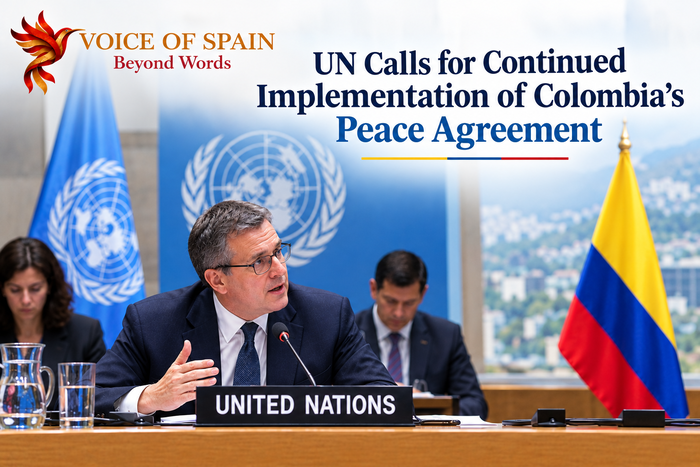
Speaking to the Security Council, Miroslav Jenca, the UN Special Representative and head of the Verification Mission in Colombia, called for comprehensive implementation of the agreement. The UN's position emphasises that progress cannot be measured solely by the demobilisation of former fighters. It also requires improvements in rural development, security, access to justice and opportunities for people living in areas historically affected by conflict.
Rural reform is one of the central pillars of the peace agreement. It seeks to address longstanding inequalities and improve conditions in rural communities through better access to land, infrastructure, public services and economic opportunities. These issues are closely connected to the broader peace process because poverty, limited state services and competition over land have contributed to instability in some regions.
The future of international oversight has also become a significant issue in the current debate. According to a report published on 15 October by Justice for Colombia, the Colombian government has sought to narrow the UN Verification Mission's role by transferring monitoring of rural reform programmes to state institutions. The government has argued that rural reform falls within the ordinary responsibilities of the Colombian state and has indicated that the UN mission should concentrate more directly on the security and reintegration of former combatants.
The proposal has prompted concerns among supporters of the peace agreement about whether reducing international monitoring could weaken accountability or delay implementation. Rural reform is closely linked to other parts of the agreement, including economic development, the replacement of illicit crops and the reintegration of former fighters. Any change to the verification arrangements could therefore have consequences beyond the rural development agenda itself.
The security of former combatants remains another major concern. People who signed the agreement and left the FARC have faced continuing threats and violence in several parts of the country. According to the report by Justice for Colombia, the UN Verification Mission has recorded hundreds of killings of peace agreement signatories since 2017. Such violence raises questions about the protection available to former combatants and the ability of the state to establish lasting security in vulnerable areas.
The peace agreement also involves transitional justice and efforts to establish the truth about abuses committed during the conflict. These mechanisms are intended to provide accountability, recognise victims and help prevent the recurrence of violence. Their implementation remains part of the wider debate over how Colombia can balance justice, reconciliation and the reintegration of former combatants into civilian society.
For communities affected by conflict, the success of the agreement depends on tangible improvements in everyday life. Access to education, healthcare, roads, employment and reliable public institutions can help rebuild confidence in the peace process. Without sustained development and protection from armed groups, some communities may remain vulnerable to recruitment, displacement and other forms of violence.
The United Nations' call for faster implementation therefore reflects a concern that the achievements of the peace process could remain fragile without consistent action. International monitoring can provide independent assessment of progress, while the Colombian government retains responsibility for implementing its commitments and protecting people across the country.
As discussions continue at the United Nations, the central question is how Colombia can move from the formal commitments of the 2016 agreement towards more consistent results on the ground. The outcome will depend on cooperation among national institutions, local communities, former combatants, civil society and international partners.
VoS STRATEGIC INSIGHT
Colombia's experience demonstrates that signing a peace agreement is only one stage of ending a conflict. Long-term stability requires the protection of former combatants, meaningful rural development, access to justice and sustained support for communities affected by violence. Changes to international monitoring should be assessed in terms of their impact on transparency and implementation. Ultimately, the agreement's credibility will depend on whether its commitments produce measurable improvements in security, opportunity and public trust.
Sources: