VoS NEWS DESK | EUROPEAN POLITICS & CONSTITUTIONAL AFFAIRS | 31 OCTOBER 2026
According to reports from the Polish Press Agency and international media, President Nawrocki was travelling to Senegal when he decided to interrupt his journey and return to Poland. His official programme had included meetings with Senegalese President Bassirou Diomaye Faye and representatives of the African Union.
However, developments surrounding the Constitutional Tribunal prompted the Polish president to change his plans. Announcing his decision, Nawrocki said that the president needed to remain in Poland during such a critical moment and confirmed that he was returning to the country.
The immediate controversy centred on the reported suspension of Constitutional Tribunal President Bogdan Święczkowski and his deputy, Bartłomiej Sochański. Judge Anna Korwin-Piotrowska announced that she would provisionally lead the tribunal following the developments.
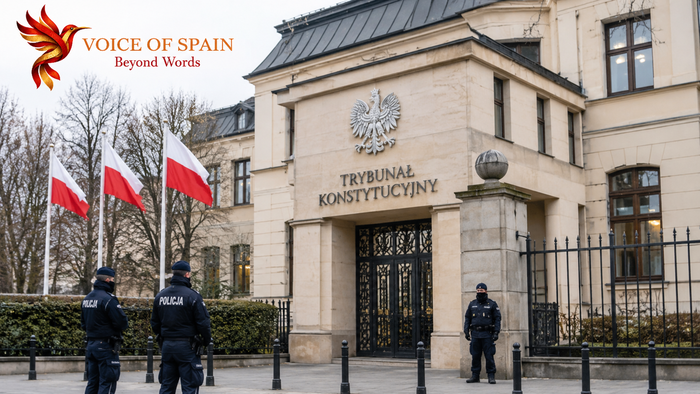
The situation quickly escalated as demonstrators gathered outside the court in Warsaw. Police officers were deployed to secure the tribunal's premises after concerns were raised about possible threats to judges and court employees, as well as the risk of public disorder. Reports indicated that some protesters breached the court's perimeter and threw objects at police officers, resulting in several detentions.
The dispute has become another major confrontation between Prime Minister Donald Tusk's pro-European government and the opposition Law and Justice (PiS) party. The disagreement is rooted in years of political conflict over judicial appointments, constitutional procedures and the independence of Poland's legal institutions.
During its previous period in power between 2015 and 2023, the Law and Justice government introduced a series of judicial reforms that attracted criticism from European institutions. Critics argued that these measures weakened judicial independence and increased political influence over the country's courts. The reforms also contributed to a prolonged dispute with the European Union, including financial penalties and the freezing of certain funding arrangements.
Since returning to government, Prime Minister Donald Tusk has made restoring judicial independence a central political priority. His administration argues that changes are necessary to address institutional problems created during the previous government's rule. However, implementing these reforms has proved difficult because President Nawrocki and opposition politicians have challenged several government decisions.
President Nawrocki, who is politically aligned with the Law and Justice camp, has previously resisted certain judicial appointments and vetoed legislation supported by the government. His position has created additional complications for an administration attempting to reorganise the judicial system and restore confidence in constitutional institutions.
The latest confrontation has further intensified the disagreement over the legitimacy of judicial appointments and the authority of the Constitutional Tribunal. Supporters of the government argue that decisive action is necessary to restore the rule of law, while opposition politicians have described the suspension of senior judicial officials as an attack on the constitutional order.
The Law and Justice leadership has strongly criticised the government's approach, with senior opposition figures joining demonstrators outside the court. The political atmosphere has become increasingly tense as both sides accuse one another of undermining democratic institutions.
The controversy also carries wider European implications. Poland is an important member of the European Union and plays a significant role in regional security, particularly because of its geographical position near Ukraine and Belarus. Any prolonged institutional crisis could affect the country's political stability, international reputation and ability to maintain consistent relations with European partners.
The situation is particularly sensitive ahead of the next parliamentary election, expected in 2027. The confrontation over the judiciary could become a central issue in the political campaign, with both governing and opposition parties seeking to present themselves as defenders of Poland's constitutional system.
International observers are closely monitoring the developments, as the dispute highlights the continuing challenges faced by European democracies in maintaining judicial independence while resolving political disagreements through constitutional procedures.
For the moment, the immediate priority remains preventing further escalation around the Constitutional Tribunal and establishing a clear legal framework for resolving the dispute. The coming days could prove crucial in determining whether Poland's political leadership can find a way forward without creating a deeper institutional confrontation.
VoS STRATEGIC INSIGHT
Poland's latest constitutional confrontation highlights the importance of maintaining a clear separation between political authority and judicial independence. A functioning democracy depends not only on elected governments and presidential institutions but also on courts that can operate independently and interpret the constitution without political interference.
The conflict between President Nawrocki and Prime Minister Tusk demonstrates how disagreements over judicial appointments and institutional reforms can develop into a wider national crisis. When political leaders disagree over the legitimacy of constitutional institutions, public confidence in the legal system can weaken, potentially creating uncertainty across the country's democratic framework.
For the European Union, developments in Poland are particularly important because the country is a major political, economic and security partner. The EU has repeatedly emphasised the importance of judicial independence, democratic accountability and the rule of law among its member states. A prolonged constitutional dispute could therefore create renewed tensions between Warsaw and European institutions.
The situation also demonstrates the difficulties involved in reversing controversial institutional reforms. Restoring judicial independence requires more than replacing officials or introducing new legislation. Any corrective measures must themselves follow constitutional procedures and maintain public confidence in the legitimacy of the institutions concerned.
Poland's political leadership now faces the challenge of resolving the dispute through dialogue, legal clarity and respect for constitutional responsibilities. If the confrontation continues to intensify, it could undermine domestic stability and distract the government from other important priorities, including economic development, European cooperation and regional security.
Ultimately, the future of Poland's constitutional system will depend on whether its political institutions can resolve their differences through lawful and democratic mechanisms. Protecting judicial independence while respecting constitutional limits must remain central to any lasting solution.
Source: Associated Press (AP), Reuters, Polish Press Agency (PAP), Polskie Radio