VoS NEWS DESK | SCIENCE & TECHNOLOGY | 1 NOVEMBER 2026
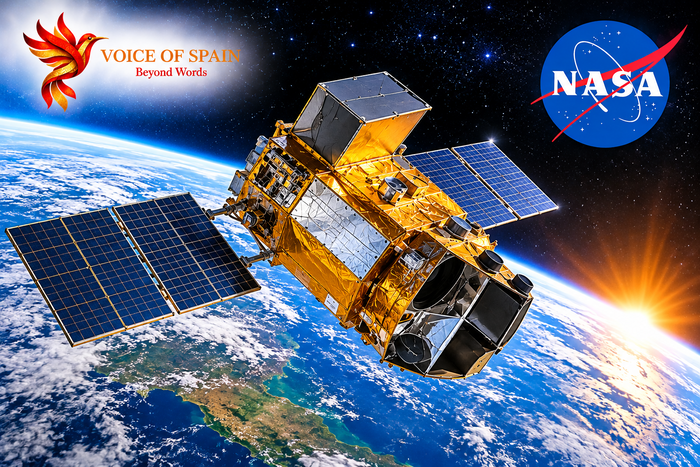
The Swift Observatory was launched on 20 November 2004 with a primary mission designed to last just two years. However, it continued operating for more than two decades, becoming one of NASA’s most important instruments for observing sudden and powerful events across the universe. Its main task was to detect gamma-ray bursts — extremely energetic explosions that can occur when massive stars collapse or compact stellar objects merge. Swift’s greatest strength was its ability to respond rapidly. When it detected a gamma-ray burst, it could identify its position and quickly turn its telescopes towards the event, allowing scientists to observe the fading afterglow before valuable information disappeared. This rapid response also enabled other observatories, including Hubble and James Webb, to investigate important discoveries in greater detail.
The threat to Swift increased as its orbit gradually became lower. Strong solar activity heated and expanded the upper atmosphere, increasing atmospheric drag on the spacecraft and accelerating its descent towards Earth. Since Swift was not equipped with the propulsion system needed to raise its own orbit, NASA explored an ambitious rescue operation. NASA partnered with Katalyst Space Technologies to develop a robotic servicing spacecraft called LINK. The spacecraft was launched on 3 July 2026 aboard a Pegasus XL rocket. Its mission was to approach Swift, capture it using robotic arms and guide it into a higher, more stable orbit.
However, the rescue operation encountered serious technical difficulties. In August, NASA announced that LINK would not be able to capture and boost Swift because of an ongoing spacecraft attitude-control problem. The rescue attempt ultimately failed to reach its main objective, and LINK itself re-entered Earth's atmosphere in September. After the rescue plan was abandoned, Swift resumed scientific observations and continued collecting valuable information about distant cosmic events. However, its declining altitude eventually made it increasingly difficult for the spacecraft to maintain stable observations.
On 20 October 2026, Swift reached an altitude of approximately 171 miles (275 kilometres) above Earth. At this level, atmospheric drag had become too strong for the observatory to operate reliably. The spacecraft entered safe mode, and its operations team sent commands that effectively brought the scientific mission to an end. NASA officially announced the conclusion of the mission on 23 October. The agency confirmed that Swift had completed its final observation on 20 October and was expected to re-enter Earth's atmosphere within the following weeks.
According to reporting by the Associated Press, the United States Space Force expects the observatory to come down around Friday, although the precise timing and location remain uncertain. Most of the approximately 1.5-tonne spacecraft is expected to burn up as it passes through the atmosphere. However, some dense components, including tungsten parts and sections of its mirrors, could potentially survive the intense heat. The spacecraft's possible re-entry zone covers a wide area, including parts of several continents. Nevertheless, any surviving debris is considered most likely to fall into the ocean. Space authorities are monitoring its changing orbital path to assess the situation as the spacecraft approaches its final descent.
Although Swift's operational mission is ending, its scientific contribution will continue through the enormous collection of observations it has left behind. During its lifetime, the observatory detected more than 2,000 gamma-ray bursts and studied over 1,400 supernova explosions. It also helped researchers investigate black holes, active galaxies, comets, asteroids and other astronomical phenomena. NASA reports that data from the mission has contributed to approximately 7,000 published scientific papers. Its publicly available archive contains around 12 terabytes of scientific information, including more than 1.5 million images captured by its ultraviolet and optical telescope. These observations will remain available to researchers, providing opportunities for further discoveries long after the spacecraft has disappeared from orbit.
VoS STRATEGIC INSIGHT
The end of NASA’s Swift Observatory highlights both the achievements and the limitations of long-running space missions. Designed for a relatively short operational period, the spacecraft continued delivering scientific discoveries for more than 20 years. Its ability to identify sudden cosmic explosions and alert other observatories made it an important part of the international astronomical research network. The unsuccessful rescue attempt also demonstrates the technical challenges involved in servicing satellites that were never designed to be repaired or moved in orbit. Capturing an existing spacecraft with a robotic servicing vehicle requires extremely precise navigation, control and coordination. Although LINK did not achieve its main objective, the experience may provide useful lessons for future satellite-maintenance and orbital-rescue projects.
For NASA and the wider scientific community, the immediate challenge will be maintaining the rapid-response capability that Swift provided. Other space observatories can continue investigating cosmic events, but replacing Swift's particular combination of speed, flexibility and multiwavelength observations will require further technological development. Swift's return to Earth therefore represents more than the retirement of an ageing telescope. It marks the conclusion of a significant chapter in space astronomy while leaving behind a scientific archive that could support research for decades.