VoS NEWS DESK | INTERNATIONAL SECURITY AND DIPLOMACY | 30 OCTOBER 2026
The deployment comes amid an increasingly serious security crisis in Haiti, where powerful criminal organisations control large areas, particularly around the capital, Port-au-Prince. Armed gangs have expanded their influence over residential communities, transport routes and important infrastructure, while the country's weakened political institutions and limited security capabilities have struggled to restore public order.
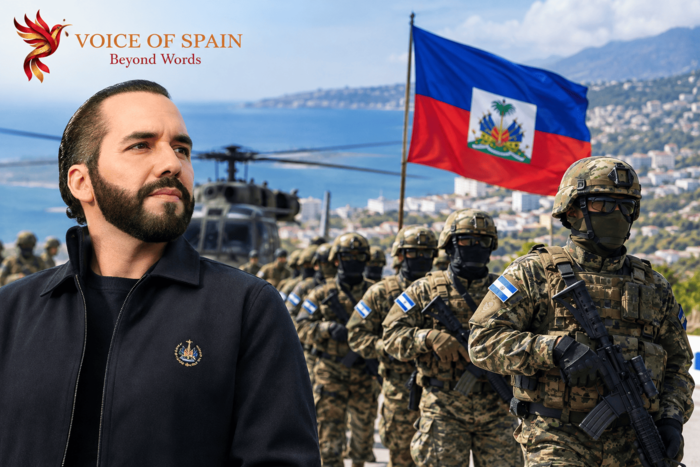
According to Reuters reporting published on 29 October, approximately 2,000 Salvadoran soldiers had arrived in Haiti by Wednesday evening, with sources indicating that the deployment could eventually reach a maximum of around 2,500 personnel. The scale of the operation has attracted international attention because it represents a substantial expansion of El Salvador's role in an international security effort far beyond its own territory.
The immediate reason behind the deployment is the disappearance of four Salvadoran aviation technicians who were serving as members of the UN-backed Gang Suppression Force in Haiti. The technicians reportedly went missing after their vehicle was attacked by armed gang members in an area controlled by criminal organisations outside Port-au-Prince on 18 October. During the incident, the vehicle caught fire, and the four personnel disappeared while attempting to escape the attack.
The incident triggered an urgent response from the Salvadoran Government. President Nayib Bukele publicly demanded the safe return of the missing personnel and warned Haitian gang leaders that his government would take stronger action if the technicians were not released. He presented the deployment as a rescue mission, insisting that the principal objective was to bring the missing Salvadorans home safely rather than initiate an independent military campaign.
The operation has also raised concerns about the possible expansion of military activities. Although the Salvadoran and Haitian authorities have described the mission as an effort to locate the missing personnel, the arrival of thousands of troops has generated questions about whether the deployment could eventually become part of a wider campaign against Haiti's armed gangs.
President Bukele has built much of his political reputation on an aggressive anti-gang strategy inside El Salvador. Since taking office in 2019, his administration has introduced extensive security operations, large-scale arrests and a prolonged state of emergency aimed at dismantling criminal networks. These measures have significantly changed the country's security environment and strengthened Bukele's popularity among many Salvadorans who previously experienced widespread gang violence.
However, the same strategy has attracted criticism from international human rights organisations. Concerns have included arbitrary detention, limited access to due process, overcrowded prisons and allegations that innocent individuals have been caught up in security operations. The possibility of applying similar methods in Haiti has therefore become an important subject of international debate.
Haiti presents a considerably different security environment from El Salvador. Its criminal organisations operate through complex networks, control strategic neighbourhoods and have developed considerable influence over local economic activities. The country's judicial system, prisons and public institutions have also been weakened by years of political instability, corruption and violence.
Security analysts have warned that a strategy based primarily on mass arrests and aggressive military operations may not produce the same results in Haiti. The country's gangs have access to weapons, territorial networks and recruitment systems that make the security challenge particularly complicated. Furthermore, some armed groups reportedly recruit minors, creating additional legal and humanitarian concerns for any military operation.
Another major issue concerns the command structure and operational responsibilities of the Salvadoran troops. Questions remain about who will exercise direct authority over the newly deployed personnel, what rules of engagement they will follow and how their activities will be coordinated with Haitian security forces and the international mission. Without clear arrangements, the possibility of confusion between different security units could increase the risks of confrontation and civilian casualties.
The international Gang Suppression Force was established to help Haitian authorities confront organised criminal groups and restore security. However, the mission has faced considerable difficulties in reaching its planned operational strength. Despite international support, the force has struggled to establish a sustained presence across gang-controlled areas, while violence has continued to affect ordinary residents.
The arrival of Salvadoran personnel could provide additional operational capacity, particularly in search-and-rescue activities and security operations. Nevertheless, the effectiveness of the deployment will depend on coordination, intelligence-sharing, logistical support and respect for international humanitarian and human rights obligations.
The financial dimension of the operation has also attracted attention. Bukele stated on Thursday that his government was covering approximately 90 per cent of the deployment's costs and that the arrival of troops was approaching completion. This announcement indicates that El Salvador is prepared to assume a substantial financial responsibility for an overseas security operation, despite the considerable resources required to maintain its own domestic security programmes.
Public opinion in El Salvador appears broadly supportive of the mission, although concerns about the safety of the deployed personnel remain significant. A survey cited by Reuters indicated strong public approval for the operation, while also showing that many citizens were worried about the possibility of Salvadoran soldiers being killed or injured in Haiti.
For Haiti, the immediate challenge remains restoring security without creating additional suffering for communities already affected by years of violence. Residents in gang-controlled areas face serious restrictions on movement, limited access to healthcare and education, economic disruption and the constant threat of armed attacks. Any new military operation must therefore consider not only its security objectives but also its consequences for civilians.
The situation also carries wider implications for regional diplomacy. El Salvador's involvement could encourage other governments to consider more direct participation in international anti-gang operations. At the same time, it may generate concerns about the use of foreign military forces in a country with a long history of external interventions and unresolved political difficulties.
The coming days will be particularly important in determining whether the deployment remains focused on locating the four missing technicians or develops into a longer-term security operation. The Salvadoran Government will face pressure to demonstrate that its intervention can achieve its stated objectives without worsening the humanitarian situation.
Ultimately, the operation represents a significant moment for both countries. For Bukele, it is an opportunity to demonstrate whether his security model can operate beyond El Salvador. For Haiti, it is another attempt to confront an increasingly dangerous criminal crisis while protecting a population that has already endured years of instability.
VoS STRATEGIC INSIGHT
El Salvador's military deployment to Haiti marks an important development in the international response to organised crime. President Nayib Bukele is attempting to extend the influence of his domestic security strategy beyond national borders, presenting the operation as both a rescue mission and a contribution to regional stability.
However, Haiti's political, institutional and security challenges are considerably different from those faced by El Salvador. Military strength alone cannot resolve the country's deeper problems, including weak institutions, poverty, political instability and the influence of armed criminal networks.
The real test will be whether the deployment can achieve its immediate objectives while protecting civilians and respecting international standards. If successful, it could strengthen El Salvador's regional influence. If poorly coordinated or excessively aggressive, however, it could deepen Haiti's security crisis and create new diplomatic complications.
Source: Reuters, Associated Press, BBC News and The Guardian.