VoS NEWS DESK | INTERNATIONAL DIPLOMACY & GLOBAL AFFAIRS | 31 OCTOBER 2026
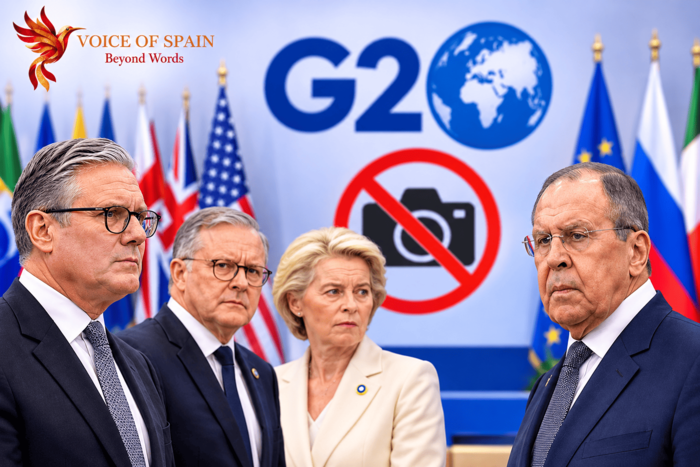
According to reports from Reuters and other international news organisations, the US State Department decided to cancel the photograph to prevent the disagreement from becoming a major distraction from the diplomatic discussions. Approximately one-third of the participants, including representatives from Australia and Canada, had expressed opposition to appearing alongside Lavrov.
Britain also maintained its position against participating in an official photograph with the Russian foreign minister. Foreign Secretary Ed Miliband attended the Atlanta meeting, where he reiterated Britain's concerns about Russia's invasion of Ukraine and the importance of defending international law, national sovereignty and the territorial integrity of states.
Germany also expressed strong opposition to the proposed photograph. Foreign Minister Johann Wadephul indicated that a joint picture with Russia would create an impression of normal diplomatic relations that, in his view, did not reflect the current political reality. European representatives had reportedly considered the possibility of arranging two separate photographs, one including Lavrov and another without him, but the United States ultimately removed the traditional photograph from the programme.
The disagreement reflects the continuing consequences of Russia's full-scale invasion of Ukraine in February 2022. Western governments have maintained diplomatic and economic pressure on Moscow, while Russia continues to defend its military actions and reject many of the positions taken by European governments.
The situation has also exposed differences between the United States and some of its traditional European allies. President Donald Trump's administration has pursued renewed diplomatic engagement with Moscow as part of its broader efforts to address the Ukraine conflict. However, several European governments remain concerned that improving relations with Russia without sufficient progress towards peace could weaken international pressure on the Kremlin.
During the meeting, US Secretary of State Marco Rubio called for greater cooperation between participating countries, warning that the international community was facing interconnected economic and geopolitical challenges. These included disruptions to energy and food supplies, trade uncertainty, restrictions on freedom of navigation and ongoing military conflicts.
The G20 foreign ministers also faced disagreements over the representation of countries at international gatherings. Russia opposed Poland's proposed participation in the G20 as a member, while the US decision not to invite South Africa, despite its position as a founding G20 member, generated further controversy. Ukraine was also absent from the Atlanta gathering.
The diplomatic tensions could complicate preparations for the next G20 leaders' summit, scheduled to take place in Florida in December under the US presidency. Although the Atlanta discussions were described as cordial by some participants, diplomats expressed doubts about the possibility of reaching a common position on the most contentious international issues.
The cancellation of a ceremonial photograph may appear to be a relatively small development, but it carries wider political significance. It demonstrates how disagreements over the Ukraine war continue to influence international diplomacy, even in forums intended to encourage cooperation between countries with different political systems and foreign policy priorities.
VoS STRATEGIC INSIGHT
The G20 photograph controversy demonstrates that international diplomacy is increasingly being shaped by political divisions rather than traditional expectations of collective unity. Although the G20 provides an important platform for major economies to discuss global challenges, disagreements over Russia's participation illustrate the difficulty of maintaining cooperation when member states hold fundamentally different positions on international conflicts.
For Britain and its European partners, maintaining a firm position on Ukraine remains closely connected to the principles of national sovereignty, territorial integrity and international law. Their refusal to participate in the photograph was therefore a symbolic diplomatic decision intended to communicate that Russia's actions cannot simply be separated from its international representation.
For the United States, however, the situation presents a complicated diplomatic challenge. Washington must balance its efforts to maintain communication with Moscow against the concerns of European allies whose security interests are directly affected by the war in Ukraine. Managing these competing priorities will be essential if the United States hopes to maintain cooperation within the G20.
The wider implications extend beyond Russia and Ukraine. Disagreements over energy security, international trade, food supplies and regional conflicts require cooperation among major economies. If geopolitical rivalries continue to dominate international meetings, the ability of institutions such as the G20 to develop practical solutions to global problems could become increasingly limited.
Ultimately, the cancellation of the photograph serves as a reminder that diplomatic unity cannot be achieved through ceremonial gestures alone. Sustainable international cooperation will require meaningful dialogue, mutual confidence and progress towards resolving the conflicts that continue to divide the international community.
Source: Reuters, Associated Press, BBC, Sky News, The Guardian