VoS NEWS DESK | INTERNATIONAL SECURITY & TECHNOLOGY | 17 OCTOBER 2026
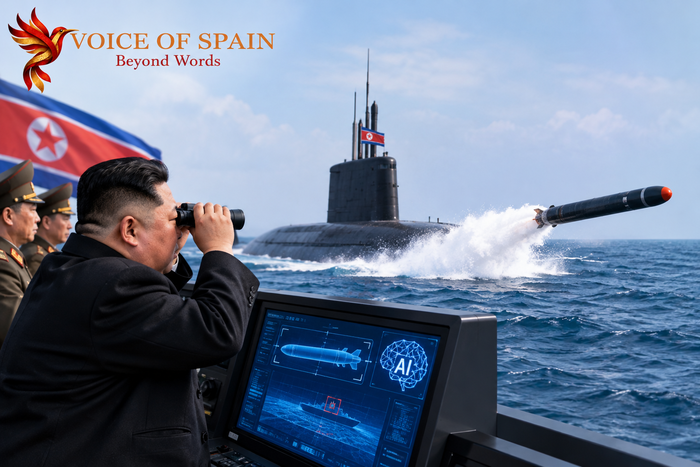
North Korea's latest announcement highlights its continuing efforts to develop advanced weapons systems and strengthen its military capabilities. According to the Korean Central News Agency (KCNA), the Zam-2.0 torpedo underwent an underwater test designed to confirm technical improvements to the weapon. The country described the system as a high-speed, precision-guided weapon and presented the test as a significant step in the development of its naval forces.
State media reported that artificial intelligence technology had been incorporated into the torpedo's target-detection and guidance functions. However, North Korea did not disclose detailed technical specifications, including the weapon's operational range, precise speed, navigation methods or the extent to which its AI functions operate independently. Consequently, the practical capabilities of the system remain difficult to assess from the available information.
The announcement comes amid continued efforts by North Korea to expand its weapons programme, including developments involving missiles, submarines and other military systems. Pyongyang has repeatedly presented technological advances as evidence of its determination to strengthen national defence and improve its ability to respond to perceived external threats.
Underwater weapons are particularly significant because they can complicate maritime surveillance and naval defence. Torpedoes designed for high speed and precision can present challenges for ships and submarines, although their actual effectiveness depends on factors such as detection systems, guidance reliability, operating conditions and the capabilities of opposing forces.
The reported integration of AI adds another dimension to the development. Artificial intelligence can potentially help military systems process sensor information, identify objects and adjust guidance decisions. Nevertheless, an official claim that a weapon uses AI does not, by itself, demonstrate that the system can independently identify targets reliably or operate effectively under combat conditions.
Independent verification is therefore important. North Korea's announcement has not provided enough technical information to establish how sophisticated the Zam-2.0 system is or how it compares with similar weapons developed elsewhere. Analysts will need to distinguish between the country's public claims, verified test results and assessments of its actual operational capabilities.
The development is also relevant to regional security in East Asia. South Korea, Japan and the United States closely monitor North Korea's weapons activities because advances in missile and naval technology can affect defence planning, military readiness and calculations about deterrence.
The Korean Peninsula remains affected by long-standing political and security tensions. North Korea's nuclear weapons programme, sanctions and stalled diplomatic efforts have contributed to a difficult regional environment. New weapons demonstrations can intensify concerns among neighbouring countries, particularly when they involve systems that may be difficult to detect or intercept.
South Korea has frequently questioned the reliability of North Korean military claims, and independent assessment remains essential in this case. The announcement alone does not establish whether the torpedo has entered operational service or whether it has been deployed in significant numbers.
The wider issue extends beyond the Korean Peninsula. Governments around the world are examining how artificial intelligence may change military decision-making, surveillance, navigation and targeting. While such technologies can improve certain technical capabilities, they also raise questions about reliability, human oversight, escalation risks and responsibility when automated systems are involved in the use of force.
International discussions on military AI increasingly focus on maintaining meaningful human control over decisions involving lethal force. Concerns include the possibility of misidentification, technical malfunction and rapid escalation during a crisis. These questions become particularly important when autonomous or semi-autonomous systems operate in complex environments where distinguishing military targets from other objects can be difficult.
North Korea's announcement is therefore likely to attract attention from regional defence analysts, even as the precise capabilities of the new torpedo remain uncertain. Future assessments will depend on further technical evidence, independent intelligence and any additional information released by North Korean authorities.
VoS STRATEGIC INSIGHT
North Korea's reported AI-guided torpedo test illustrates the growing intersection between artificial intelligence and military competition. Even when the practical capabilities of a new system remain unverified, its announcement can influence regional threat assessments and encourage neighbouring countries to review their defence strategies.
The central question is not simply whether a weapon incorporates AI, but whether the technology improves its reliability, target identification and performance under real operational conditions. Public claims should therefore be evaluated carefully rather than treated as proof of a major technological breakthrough.
The development also reinforces the importance of international discussions about military AI, particularly safeguards against accidental escalation and the need for appropriate human oversight. As weapons become more technologically sophisticated, transparency and reliable communication between governments become increasingly important.
Ultimately, regional stability will depend not only on military preparedness but also on diplomatic engagement and credible mechanisms for reducing tensions. Without these measures, successive weapons demonstrations risk deepening mistrust and increasing the possibility of miscalculation in an already sensitive security environment.
Source: Associated Press — North Korea says it tested new torpedo system with AI capabilities · Yonhap News Agency — North Korea tests new precision-guided torpedo using AI