VoS NEWS DESK | SCIENCE & TECHNOLOGY | 3 OCTOBER 2026
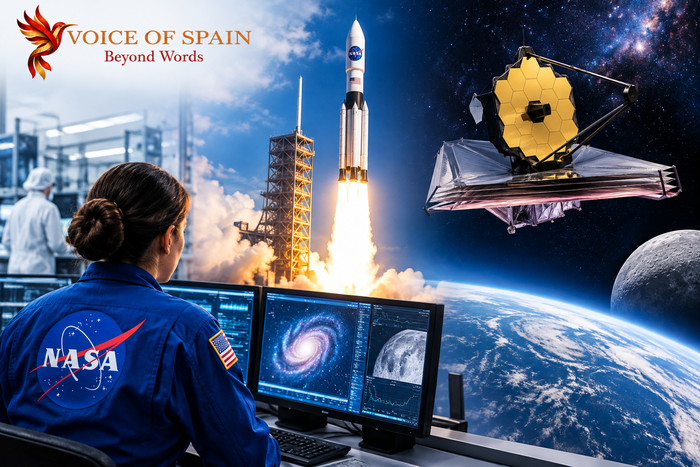
Among the latest developments is NASA's work with small spacecraft designed to demonstrate new technologies in orbit. Three NASA-supported small spacecraft were launched on 1 October as part of efforts to demonstrate new propulsion technologies, study astrophysical phenomena and support future orbital operations.
Small satellites and spacecraft have become increasingly important in modern space exploration because they can provide opportunities to test new technologies without requiring the scale and cost of some traditional large missions.
NASA is also continuing preparations for the Nancy Grace Roman Space Telescope, one of its major upcoming astronomical observatories. The telescope is designed to carry out extremely wide surveys of the universe and investigate major questions involving dark energy, dark matter and planets beyond our Solar System.
In September, NASA successfully activated Roman's Wide Field Instrument, a 300-megapixel infrared camera designed to observe enormous areas of the sky while maintaining a high level of detail. The instrument will allow astronomers to collect large quantities of astronomical data during its planned scientific surveys.
Roman's Wide Field Instrument is particularly significant because its observations will cover large areas of the sky much faster than many previous space telescopes. Scientists expect the mission to provide valuable information about the distribution of matter, the evolution of galaxies and the nature of dark energy.
The telescope also contains a Coronagraph Instrument, a technology designed to block the overwhelming brightness of stars so that scientists can attempt to directly observe faint planets orbiting those stars.
Directly imaging exoplanets is technically challenging because a planet can be dramatically fainter than the star around which it orbits. Roman's coronagraph will therefore serve as an important demonstration of technologies that could support future missions designed to study distant planetary systems.
NASA has reported that the Roman mission remains on track to release its first scientific images in early 2027, following continued calibration and testing.
At the same time, NASA's October skywatching programme is highlighting several astronomical events visible from Earth, including Saturn at opposition, the Orionid meteor shower and the Moon's close passage near the Pleiades star cluster.
These developments demonstrate how modern space science combines fundamental research with advanced engineering. New instruments must operate in extremely demanding environments while producing highly precise measurements that can be used by scientists around the world.
The growing use of smaller spacecraft is also changing the space sector. Compact missions can provide technology demonstrations and scientific observations while supporting a broader range of organisations and research programmes.
The combination of new spacecraft, advanced instruments and increasingly powerful astronomical surveys is expected to expand humanity's ability to study both our Solar System and the distant universe.
VoS STRATEGIC INSIGHT
NASA's latest developments highlight two major directions in modern space exploration: advanced scientific instruments and smaller, technology-focused spacecraft. Roman's new infrared instrument could significantly expand astronomical surveys, while small-spacecraft missions are providing opportunities to test technologies that may support future exploration and orbital operations.
Source: NASA; NASA Science.