VoS NEWS DESK | INTERNATIONAL NEWS | 25 OCTOBER 2026
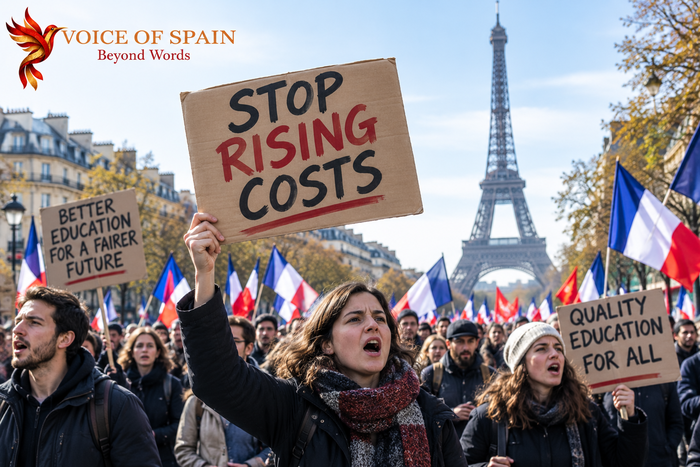
France’s latest demonstrations have become a significant national political and social issue, reflecting dissatisfaction that extends beyond any single government decision. According to figures reported by the French Interior Ministry, approximately 410,000 people participated in demonstrations across the country on Saturday, 24 October. Trade unions gave a substantially higher estimate, illustrating the differences that can emerge between official attendance figures and organisers’ assessments. Paris was among the main centres of mobilisation, with large crowds gathering to express their concerns about the cost of living, public spending and the quality of essential services.
The protests developed from student demonstrations over conditions in schools and universities into a broader movement attracting workers, trade union members and other sections of society. Students have raised concerns about staff shortages, inadequate facilities and insufficient investment in education. As the demonstrations expanded, economic grievances became increasingly prominent, including the cost of fuel, housing expenses, everyday essentials and the pressure on household budgets.
For many demonstrators, these issues are closely connected. Rising prices can make it more difficult for families to pay rent, travel to work, meet energy bills and provide educational opportunities for their children. Workers on limited incomes may find that wage increases fail to keep pace with essential expenses, while students face uncertainty about educational opportunities and future employment. These concerns have helped broaden the movement beyond its original focus on schools and public education.
The scale of the mobilisation has also drawn attention to the government's difficult economic choices. France must balance demands for better-funded public services and support for households with concerns about public expenditure and national debt. Reducing spending may create difficulties for schools and other services, while expanding financial support can place additional pressure on public finances. The government therefore faces the challenge of finding measures that respond to immediate public needs without creating further long-term economic problems.
The political implications are particularly significant as France approaches its next presidential election, scheduled for 2027. Opposition parties have sought to use the unrest to challenge the government's economic record and present alternative policies. Different political groups have also offered contrasting explanations for the protests, with disagreements over taxation, public expenditure, policing and the distribution of economic resources.
President Emmanuel Macron has faced pressure to demonstrate that the government understands the concerns being expressed on the streets. However, the demonstrations involve a wide range of demands, making it difficult to identify a single measure that would satisfy every group. Some protesters want better wages and stronger social protections, while others prioritise investment in education, affordable housing and improved public services.
Security has emerged as another central issue. Authorities deployed approximately 70,000 police officers and gendarmes nationwide during the latest demonstrations. While many marches remained peaceful, violent incidents occurred in some locations, including confrontations with security forces and reports of damage to property. Police used tear gas and water cannon in response to disorder in certain areas. The authorities have sought to prevent a repeat of the more extensive violence witnessed during previous demonstrations.
The situation has renewed debate about the relationship between the right to protest and the responsibility of the state to protect people and property. Peaceful demonstrations are an important means through which citizens can communicate their concerns, demand accountability and influence public policy. At the same time, violence, looting and attacks on public infrastructure can endanger residents, disrupt businesses and undermine the ability of peaceful demonstrators to make their voices heard.
Local businesses have also been affected by the unrest. Shops may close early or board up their windows in anticipation of disorder, while restrictions around major streets and public buildings can disrupt transport, tourism and ordinary commercial activity. Small businesses are particularly vulnerable when property damage, lost trading hours and security costs place additional pressure on already limited financial resources.
The impact extends beyond the immediate economic losses. Repeated confrontations can weaken public confidence, deepen divisions between communities and authorities, and make negotiations more difficult. For this reason, the government's response will need to address both public safety and the underlying grievances that have contributed to the demonstrations.
Another important concern is the future of education. Demands for more teachers, better facilities and adequate support for students raise questions about how public investment should be distributed. Education is not only a social service but also a major factor in long-term economic productivity, employment opportunities and social mobility. Insufficient investment can disproportionately affect students from lower-income households, who may have fewer alternatives when public institutions struggle to provide adequate facilities.
The demonstrations also reflect a broader European debate about affordability and public services. Across several countries, households have expressed concerns about housing costs, energy prices, wages and the ability of governments to maintain essential services. Although the circumstances differ from one country to another, these shared concerns have made economic inequality and the cost of living prominent issues in European politics.
For the French government, the immediate challenge is to prevent further violence while establishing credible channels for dialogue with students, unions, workers and other affected groups. Meaningful discussions, transparent decisions about public spending and practical measures to ease financial pressure could help reduce tensions. However, any lasting improvement will depend on whether citizens see concrete progress rather than promises alone.
France’s latest protests demonstrate how economic pressure, dissatisfaction with public services and political frustration can combine to create a nationwide movement. The coming weeks will be important in determining whether dialogue and policy changes can ease the situation or whether public anger will continue to intensify.
VoS STRATEGIC INSIGHT
France’s demonstrations underline the importance of treating economic hardship and public-service concerns as connected policy challenges rather than isolated complaints. When households face rising expenses while schools and other public institutions struggle with limited resources, frustration can spread across different sections of society and become a wider question of political confidence.
A sustainable response requires more than additional security deployments. Governments need to communicate clearly about economic constraints, explain how public money is being allocated and establish practical priorities for education, housing and household support. Dialogue with trade unions, students and local communities can help identify workable solutions and reduce the risk of further confrontation.
At the same time, protecting peaceful protest and enforcing the law against violence must remain compatible objectives. Effective policing, accountability and respect for civil liberties can help preserve public confidence while preventing demonstrations from becoming dangerous.
The longer-term lesson is that public stability depends partly on whether citizens believe their concerns are being heard and addressed fairly. Policies that improve access to education, protect purchasing power and strengthen essential services may contribute to restoring trust, but their effectiveness will ultimately be judged by their results.
Source: Reuters