VoS NEWS DESK | INTERNATIONAL POLITICS | 26 OCTOBER 2026
The election has attracted international attention because of Brazil’s importance as Latin America’s largest economy and one of the most influential countries in the developing world. The result represents a significant political achievement for Lula, whose long career has been shaped by debates over poverty reduction, workers’ rights, economic management and the role of the Brazilian state.
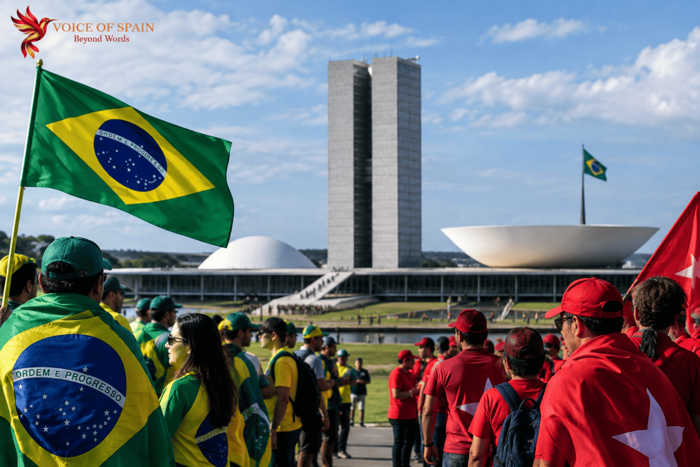
According to the official electoral announcement, Lula secured 64,256,232 votes, while Flávio Bolsonaro received 59,826,041. More than 128 million voters participated in the second round, demonstrating the scale of public engagement in a contest that divided the electorate between two sharply contrasting political visions.
Lula’s victory follows a campaign in which both candidates sought to persuade voters that their approach would provide greater economic security, improve living standards and strengthen Brazil’s position internationally. The narrow margin indicates that, although Lula has won another mandate, a substantial section of the electorate remains aligned with the political movement represented by Bolsonaro.
The result also reinforces the importance of Brazil’s electoral institutions. The Superior Electoral Court oversees the country’s voting process and publishes official results, providing the institutional framework through which the outcome of a closely contested election is determined. The court’s announcement confirmed Lula’s victory while bringing the immediate uncertainty surrounding the presidential contest to an end.
The economic debate was central to the campaign. Brazil faces continuing pressure to expand employment opportunities, improve public services and protect household purchasing power while maintaining confidence among investors and businesses. For many voters, the election was not simply a judgement on political personalities but a decision about which administration could deliver more reliable economic prospects.
Lula’s political identity has long been associated with social programmes and efforts to reduce poverty and inequality. Supporters view these policies as essential to expanding opportunity for lower-income communities, while critics question the cost of government spending and the effectiveness of some economic measures. His new mandate will therefore bring renewed expectations that social commitments can be translated into measurable improvements in everyday life.
Flávio Bolsonaro, meanwhile, represented a political movement closely associated with his father, former president Jair Bolsonaro. His campaign appealed to voters seeking an alternative to Lula’s administration and reflected the continuing influence of conservative politics in Brazil. Although he fell short of winning the presidency, the result demonstrates that opposition forces retain substantial electoral support.
The close result presents an important challenge for national unity. Brazil’s political divisions extend across questions of taxation, public security, environmental protection, social spending and the responsibilities of government. Lula will need to govern beyond his electoral base if he is to secure broader confidence in his administration and advance legislation in a politically divided country.
Brazil’s international role will also remain significant. As a major agricultural producer, an important commodity exporter and a prominent voice among developing economies, the country has considerable influence over global food markets, environmental discussions and international economic cooperation. Its approach to climate policy, trade and relations with major powers will be closely watched by governments and investors.
The Amazon rainforest is another important issue for the administration. Brazil’s environmental policies influence international discussions about deforestation, biodiversity and climate change. The government will face expectations to balance economic development with the protection of ecosystems that are important to both Brazil and the wider world.
At the same time, the administration must address domestic expectations concerning healthcare, education, infrastructure and public safety. Electoral victories create political opportunities, but the practical test begins when campaign commitments must be converted into policies, budgets and public services.
The narrow margin of victory also makes communication with opposition voters particularly important. Political disagreement is a normal feature of democratic societies, but persistent hostility can make it more difficult to reach compromises on major national priorities. Transparent decision-making, respect for democratic institutions and constructive parliamentary engagement will be essential to maintaining public confidence.
Brazil’s next political chapter will consequently be shaped by more than the election result itself. The effectiveness of economic management, the delivery of social programmes and the government’s ability to work across political divisions will determine whether the new administration can build lasting public support.
VoS STRATEGIC INSIGHT
Lula’s re-election illustrates how closely contested elections can produce a clear winner while leaving a country politically divided. A majority provides a mandate to govern, but it does not eliminate the responsibility to listen to voters who supported the opposition.
The principal challenge for Brazil will be turning electoral support into tangible progress. Policies that improve employment, protect purchasing power, strengthen public services and encourage sustainable investment will be important indicators of the administration’s performance.
Brazil’s international influence also gives the result significance beyond its borders. Decisions concerning agricultural trade, environmental protection and economic cooperation can affect international markets and diplomatic relationships.
Ultimately, the durability of Lula’s renewed mandate will depend on results rather than the symbolism of victory. Economic stability, institutional accountability and the ability to reduce political polarisation will be central to determining the country’s direction over the coming years.
Source: Brazil’s Superior Electoral Court (TSE)