VoS NEWS DESK | INTERNATIONAL DIPLOMACY | 25 OCTOBER 2026
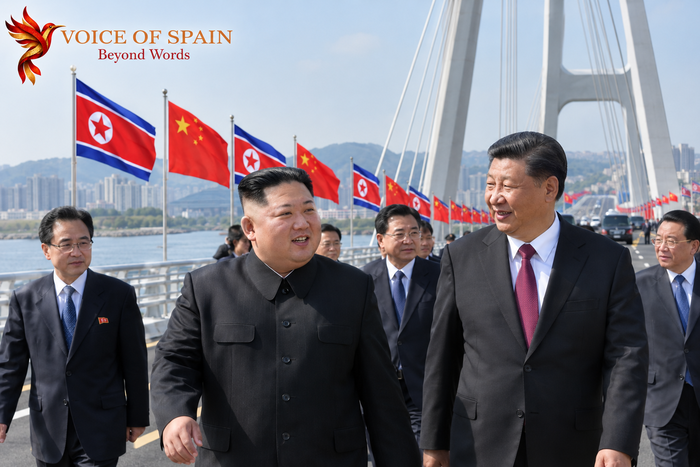
Kim’s journey across the New Yalu River Bridge has attracted international attention because of the economic and strategic significance of the infrastructure project. The crossing links Sinuiju, in north-western North Korea, with Dandong, in China’s Liaoning province. The bridge spans approximately three kilometres and provides an important new route between the two countries.
China completed construction of the bridge in 2014, but its full opening was delayed for years as the necessary connecting roads and customs facilities on the North Korean side remained incomplete. Its opening this month represents an important step towards improving transport links between the countries and reducing logistical barriers to cross-border commerce.
Kim’s decision to use the bridge for his visit gave the journey significance beyond a routine diplomatic engagement. Infrastructure projects can serve as visible demonstrations of political cooperation, particularly when they connect neighbouring countries whose economies and security interests are closely linked. In this case, the crossing provides a practical opportunity to expand trade while signalling that both governments want to strengthen their bilateral relationship.
During his visit, Kim met Wang Huning, a senior member of China’s political leadership. Chinese state media reported that the two visited an automobile factory in Dandong and a memorial associated with the Korean War. The visits highlighted both the economic dimension of the relationship and its historical foundations. North Korea and China fought on the same side during the 1950–1953 Korean War, and their wartime association continues to feature prominently in official accounts of bilateral friendship.
Kim returned to North Korea on Sunday, according to North Korean state media. The visit was brief, but its timing and public presentation reinforced the importance both governments attach to maintaining close relations. The journey also took place ahead of the anniversary of China’s entry into the Korean War, adding historical significance to the occasion.
China remains North Korea’s principal economic partner and an important source of diplomatic support. Years of sanctions, restrictions on international trade and North Korea’s limited access to global markets have made economic ties with China particularly important to Pyongyang. Cross-border commerce provides access to goods and supplies that North Korea needs, while Chinese businesses and border communities have an interest in maintaining functioning trade routes.
The new bridge could make the movement of industrial equipment, raw materials and energy products easier. Improved transport capacity may also help businesses manage shipments more efficiently and reduce bottlenecks associated with older border infrastructure. If customs procedures and supporting facilities operate effectively, the crossing could become an increasingly important component of bilateral trade.
However, the opening of the bridge does not automatically guarantee a dramatic expansion in commerce. Actual trade volumes will depend on economic demand, border regulations, payment arrangements, international sanctions and the willingness of businesses to engage in cross-border activity. North Korea’s broader economic conditions and its relations with other countries will also influence how effectively the new infrastructure is used.
For China, stronger economic connections with North Korea could help support stability along its north-eastern border and reinforce Beijing’s influence in regional affairs. China has traditionally sought to avoid instability on the Korean Peninsula, where conflict could create serious humanitarian, security and economic consequences for neighbouring countries.
For North Korea, improved transport links could provide greater flexibility in obtaining essential supplies and supporting domestic development. Better connections may also help Pyongyang demonstrate that it can strengthen economic cooperation with a major neighbour despite continuing international restrictions.
Nevertheless, the relationship is not without complications. North Korea has expanded its military cooperation with Russia in recent years, prompting questions among regional analysts about how Pyongyang will balance its relationships with Moscow and Beijing. While the countries share certain strategic interests, their priorities are not necessarily identical. China remains focused on regional stability and its wider economic interests, while North Korea seeks security guarantees, diplomatic leverage and support for its own strategic objectives.
The visit also comes amid uncertainty over possible renewed contact between Kim and US President Donald Trump. Trump has expressed interest in engaging with the North Korean leader, but the prospects for a meeting in 2026 have appeared uncertain. The upcoming Asia-Pacific Economic Cooperation summit in China is another event that could attract international attention to regional diplomacy, although a meeting between the two leaders should not be assumed without official confirmation.
Relations between North Korea and the United States remain complicated by Pyongyang’s nuclear weapons programme, international sanctions and wider security concerns involving South Korea and Japan. China’s position is important because Beijing maintains communication with North Korea while also managing relationships with Washington and other regional powers.
The bridge’s significance therefore extends beyond the practical movement of goods. Infrastructure can create opportunities for economic engagement, regular official contact and closer coordination between neighbouring governments. At the same time, greater trade does not necessarily mean that long-standing disputes over nuclear weapons, sanctions or regional security will be resolved.
For residents and businesses in the border region, the opening may eventually create additional opportunities associated with transport, logistics and commercial activity. However, the scale of any benefits will depend on the reliability of cross-border operations, the availability of supporting facilities and the broader political environment.
The international community will continue to watch whether the improved connection produces measurable economic gains and whether the warmer diplomatic atmosphere leads to further high-level exchanges. For now, Kim’s journey has provided a visible indication that both governments are interested in giving their relationship renewed economic momentum.
VoS STRATEGIC INSIGHT
The opening of the New Yalu River Bridge demonstrates how transport infrastructure can become an instrument of economic policy and diplomacy. By improving the physical connection between North Korea and China, the project creates the potential for more efficient trade, stronger border-region commerce and increased official engagement.
However, the strategic importance of the bridge should be assessed through its practical results rather than symbolism alone. Trade volumes, customs efficiency, the availability of essential goods and the consistency of cross-border operations will determine whether the project delivers lasting economic value.
The visit also highlights the complexity of North Korea’s international relationships. Closer ties with China can coexist with expanded cooperation with Russia, while Pyongyang continues to face difficult relations with the United States and other countries over security and nuclear issues.
For regional stability, stronger economic connections could create opportunities for communication, but they cannot substitute for diplomatic progress on major security concerns. The wider significance of Kim’s visit will therefore depend on whether the renewed emphasis on cooperation develops into sustained engagement and contributes to a more predictable regional environment.
Source: Reuters