VoS NEWS DESK | BUSINESS | 20 September 2026
The change marks another major stage in the long-planned succession at Berkshire Hathaway, one of the world's largest and most closely watched conglomerates. Warren Buffett had served as Berkshire's chairman since 1970 after taking control of the company in 1965 and transforming it from a struggling textile business into a diversified global enterprise.
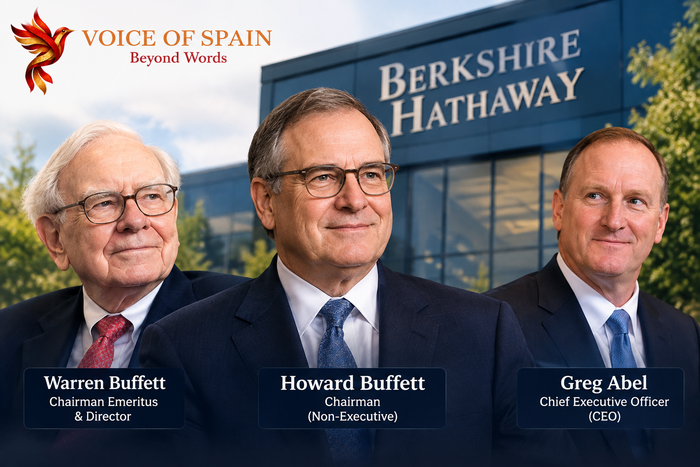
Howard Buffett, aged 71, has been a member of Berkshire Hathaway's board since 1993, giving him more than three decades of experience as a director. In his new position, however, he will serve as non-executive chairman, rather than taking over the company's day-to-day management.
The operational leadership of Berkshire remains with Greg Abel, who became chief executive officer at the beginning of 2026 after Warren Buffett handed over the CEO position. Abel is responsible for running the company's businesses and making the major operational decisions, while Howard Buffett's new role is focused primarily on corporate culture and values.
In Berkshire's official announcement, Warren Buffett said Howard would be responsible for guarding the company's culture and values, while Greg Abel would run the business. The statement described Howard's long period as a Berkshire director as an important part of his preparation for the chairmanship.
The distinction between the chairman and CEO roles is particularly important in Berkshire's new leadership structure. Howard Buffett will not be responsible for Berkshire's daily operations, investment decisions or management of its numerous subsidiaries. Those responsibilities remain with Abel and the company's executive leadership.
Berkshire Hathaway operates through a large collection of businesses spanning insurance, railroads, energy, manufacturing, retail and other sectors. Its portfolio includes businesses such as GEICO, BNSF Railway and Dairy Queen, alongside substantial investments in publicly traded companies.
Howard Buffett's background also extends beyond Berkshire. He has served as chairman and CEO of the Howard G. Buffett Foundation, which focuses on humanitarian and conservation-related work. Berkshire's earlier corporate records also listed him as a former director of Coca-Cola and a director with experience in other organisations.
His appointment therefore represents a governance role rather than a conventional CEO succession. Warren Buffett's son is expected to focus on maintaining the principles that have characterised Berkshire's corporate structure, including its decentralised management system and relationship with shareholders.
Warren Buffett will continue to remain a member of Berkshire Hathaway's board following his transition to chairman emeritus. This means that although he no longer holds the company's chairmanship, he remains formally connected to Berkshire's governance.
The transition follows Warren Buffett's decision to step down as CEO at the start of 2026. Greg Abel had been identified as his successor before formally assuming the chief executive role, making the change in the chairmanship the latest stage in Berkshire's broader leadership transition.
The company has now separated its two most important leadership responsibilities between Abel and Howard Buffett. Abel oversees the business, while Howard Buffett's chairmanship is centred on the board and the preservation of Berkshire's corporate culture.
The change comes as Berkshire continues to manage a vast collection of businesses and a large investment portfolio. Recent reports have highlighted the company's substantial cash holdings and new investment decisions under Abel's leadership, illustrating that the company's operational direction is already being handled by the new CEO.
For Berkshire shareholders, the transition represents a formal change in the leadership structure that had been associated with Warren Buffett for decades. The company says Buffett will remain a director and shareholder, while Howard Buffett takes on the chairmanship and Greg Abel continues as CEO.
The succession also demonstrates that Berkshire's transition is not centred on replacing Warren Buffett with a single individual in every aspect of his former role. Instead, responsibilities have been divided between the company's new CEO and its new non-executive chairman.
VoS STRATEGIC INSIGHT
Howard Buffett's appointment completes another major step in Berkshire Hathaway's leadership transition. He succeeds Warren Buffett as chairman after serving on Berkshire's board since 1993, while Greg Abel remains responsible for running the company as CEO.
The structure gives Howard Buffett a primarily governance and cultural role rather than an operational management position. Warren Buffett, meanwhile, becomes chairman emeritus and remains a director, preserving a formal connection with the company he led for decades.
The next phase of Berkshire Hathaway's leadership will therefore involve Greg Abel overseeing operations and Howard Buffett serving as non-executive chairman, while Warren Buffett remains on the board.
Source: Berkshire Hathaway; Reuters; Associated Press.