
VoS NEWS DESK | INTERNATIONAL NEWS | 18 OCTOBER 2026
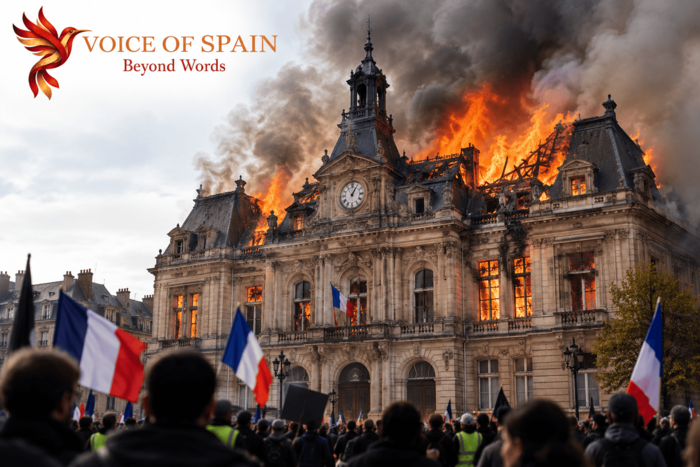
The historic town hall of Limoges in central France has been severely damaged by a major fire that broke out during violent unrest on 17 October. The incident occurred towards the end of a demonstration against the rising cost of living, following confrontations involving protesters and police. According to reports from French authorities and international media, masked individuals broke windows, entered the building and set it alight. The fire spread rapidly through the structure, causing extensive destruction to the roof and upper sections.
The town hall, inaugurated in 1883, is one of Limoges’ prominent historic civic buildings. Its architecture and long association with municipal administration have made it an important part of the city’s identity. Local prefect Maurice Barate described the destruction as a major heritage disaster, reporting that the roof had collapsed onto the lower floors, with the western wing among the remaining sections. The full extent of the structural damage and the work required to stabilise the building were still being assessed as reports emerged on 18 October.
The destruction has shocked residents because the town hall represents more than a municipal workplace. It is a public institution associated with local government, civic services and the historical development of Limoges. The scale of the damage has raised immediate questions about the future of the building, the preservation of its architectural features and the resources that may be needed for restoration. Specialists will need to determine whether surviving sections can be secured and repaired or whether parts of the structure will require extensive reconstruction.
The fire occurred against a wider background of public dissatisfaction over household expenses and the quality of essential public services. Demonstrators across France have voiced concerns about the cost of food, fuel and energy, alongside demands for improved wages, pensions and education provision. For many households, the pressure of meeting everyday expenses has become a central political and social issue, bringing together people with different grievances against the government's economic and public-service policies.
The demonstrations also reflected frustration over conditions in schools and concerns about shortages of teachers and inadequate educational resources. Student organisations and trade unions joined the wider mobilisation, arguing for better-funded public services and improved working conditions. These issues have broadened the protests beyond a single economic demand, turning them into a larger expression of dissatisfaction with living standards and government priorities.
Reports indicated that hundreds of thousands of people participated in demonstrations across numerous French cities, although estimates varied between sources. Many marches remained peaceful, with participants gathering to express their concerns through public demonstrations. However, violent incidents occurred in several locations as groups broke away from demonstrations, clashed with police, damaged property and targeted public buildings.
The distinction between peaceful demonstrators and those responsible for violence is important. The concerns over living costs and public services have drawn a broad range of participants, but attacks on buildings and other acts of destruction have created additional risks for residents, emergency workers and public institutions.
Limoges was not the only city affected by the unrest. Reports also described serious incidents in Marseille and Lyon, where public buildings were targeted and fires caused damage. In Marseille, masked individuals reportedly forced their way into the town hall, while in Lyon a fire damaged the city's tourism office. Other cities experienced confrontations, looting, fires and the use of tear gas by police as authorities attempted to restore order.
The spread of violence across several urban centres has increased pressure on security agencies to protect public buildings and maintain access to essential services. Municipal offices play an important role in the everyday functioning of local communities, handling administrative matters and providing services to residents. Damage to these facilities can disrupt operations long after demonstrations have ended.
Emergency services have also faced difficult conditions as they responded to fires and incidents occurring alongside large crowds. Firefighters must be able to reach burning buildings safely, while police are required to manage public gatherings without unnecessarily endangering peaceful demonstrators. The simultaneous occurrence of demonstrations, property damage and clashes has made the response particularly challenging.
The unrest has also renewed debate about the responsibilities of protest organisers, the conduct of individuals who commit criminal acts and the proportionality of police responses. Authorities have condemned attacks on public buildings, while some demonstrators have raised concerns about the handling of protests and the use of force by law enforcement. These questions are likely to remain part of the public discussion as investigations progress.
The French government now faces the challenge of responding to the violence while addressing the wider economic and social concerns that have brought people onto the streets. President Emmanuel Macron has condemned the destruction and pledged that those responsible will face legal consequences. Government officials have also criticised violent groups and stressed the need to protect public institutions.
The authorities must now pursue investigations into the fire at Limoges town hall, identify those responsible and establish how the attack developed. Evidence gathering, witness accounts and assessments of the damage will be important in determining the circumstances surrounding the incident. Any criminal proceedings will need to establish individual responsibility through the appropriate legal process.
At the same time, the unrest presents a broader policy challenge. Measures focused exclusively on public order may not resolve the economic pressures and dissatisfaction that have motivated many participants. Rising household expenses, concerns over public-sector resources and dissatisfaction with education provision require separate attention from the criminal investigation into the destruction of property.
The coming days will be important in determining whether tensions ease or further demonstrations take place. Government engagement with trade unions, student representatives and other groups could help clarify the demands being raised and identify areas where practical responses are possible. However, restoring confidence will require both effective law enforcement and credible engagement with the concerns of the public.
The destruction of the Limoges town hall has highlighted the vulnerability of historic buildings during periods of civil unrest. Such structures often require specialised maintenance and restoration, and damage caused by intense fires can affect roofs, timber frameworks, masonry, decorative features and internal spaces. Even where parts of a building remain standing, the recovery process may be complex and expensive.
A detailed structural assessment will be essential before decisions can be made about restoration. Conservation specialists and local authorities will need to identify surviving architectural elements, determine the stability of the remaining structure and consider how the building's historical character can be preserved. The cost of repairs, the availability of suitable materials and the need to maintain public safety may all influence the timetable.
The incident also raises questions about how cities can better protect important public buildings during large demonstrations. Emergency planning, fire prevention measures, rapid coordination between police and firefighters, and the protection of vulnerable entrances may help reduce risks. However, such precautions must be balanced with the right to peaceful assembly and the need for public spaces to remain accessible.
For residents of Limoges, the damage is not simply a matter of rebuilding a municipal facility. It represents the loss of a significant historic landmark and a reminder of how quickly public disorder can cause lasting harm to a community's heritage.
The wider protests demonstrate that economic pressures and public-service concerns remain important issues in France. The challenge for the government will be to distinguish legitimate public grievances from criminal acts, protect the country's institutions and cultural heritage, and respond constructively to the concerns raised by demonstrators.
VoS STRATEGIC INSIGHT
The destruction of Limoges’ historic town hall illustrates how economic dissatisfaction can coincide with serious public disorder, creating consequences that extend well beyond the immediate demonstrations. Rising living costs and concerns about public services deserve meaningful public debate, but attacks on historic buildings impose lasting costs on local communities and future generations.
France now faces two connected challenges: ensuring accountability for those responsible for violence and addressing the underlying social and economic concerns expressed during the protests. A sustainable response will require proportionate policing, transparent investigations, constructive dialogue with students and trade unions, and practical policies that respond to pressures on household budgets and public services.
The future of the Limoges town hall will also test the country's commitment to protecting its architectural heritage. Preserving what remains, establishing the circumstances of the fire and planning an appropriate restoration will be essential steps in the recovery of the city. Ultimately, rebuilding public confidence will depend not only on restoring damaged buildings, but also on strengthening the relationship between public institutions and the communities they serve.
Sources:
Euronews — Historic Limoges Town Hall Engulfed in Flames Amid Protests in France
ABC News — Buildings Burn and Police Use Tear Gas During French Education and Cost-of-Living Rallies
Associated Press — Clashes, Fires and Looting Break Out as Protesters Rally Across France
Reuters — Mass Protests in France Spiral into Worst Riots in Years