
VoS NEWS DESK | SCIENCE & TECHNOLOGY | 18 OCTOBER 2026
The launch of Gemini 4 Argon comes at a time when technology companies are competing to develop AI systems that can perform increasingly sophisticated tasks. Rather than focusing exclusively on generating text, answering questions or summarising documents, developers are working towards systems capable of assisting with extended projects, analysing complex information and supporting professional decision-making.
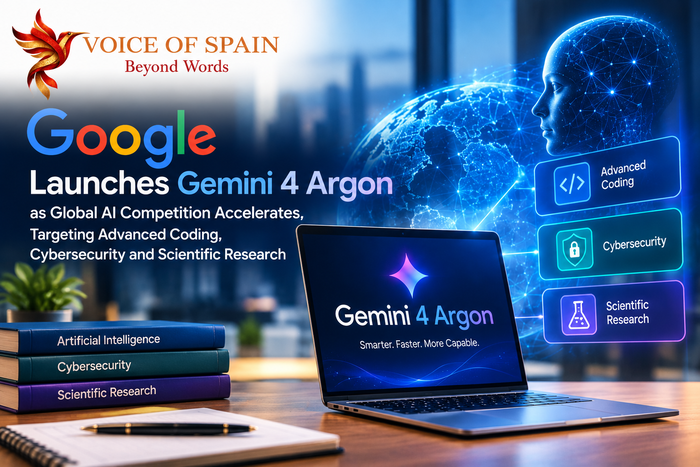
According to reporting by Reuters, Google designed Gemini 4 Argon to handle demanding assignments involving coding, financial analysis, legal work, cybersecurity and scientific applications. The model is aimed at developers and businesses that require AI tools capable of following complicated instructions and working through tasks that involve multiple stages.
This direction reflects a broader change in the technology industry. AI is increasingly being developed as a working tool that can assist with practical responsibilities, rather than simply as a conversational assistant. Businesses are exploring how these systems might help employees review documents, develop software, analyse data and complete repetitive administrative work more efficiently.
One of the principal areas highlighted in Google's announcement is the model's ability to work on complex coding and software-engineering assignments. Traditional programming assistants can suggest lines of code or explain technical problems, but more advanced systems aim to help developers work through larger projects, identify errors and coordinate multiple stages of software development.
Google has reported improvements in coding productivity among early users of its Antigravity development tool. According to the company, teams using Gemini 4 Argon through Antigravity recorded an increase of more than 35 per cent in agentic code submissions and a reduction of nearly one-third in code rollbacks. These figures are company-reported results rather than independent proof that every organisation will achieve comparable improvements.
The implications could be significant for software companies, start-ups and organisations seeking to modernise their digital services. AI-assisted development may help teams produce prototypes more quickly, examine large codebases and automate parts of testing and maintenance. However, developers will still need to verify the accuracy, security and reliability of generated code, particularly where software is used in banking, healthcare, transport or other critical services.
Cybersecurity is another important focus of the new model. As organisations increasingly depend on cloud services, connected devices and digital infrastructure, identifying vulnerabilities before attackers exploit them has become a major challenge.
Google has expanded its Fairwind programme to provide additional vetted cybersecurity partners with access to a specialised version of its technology designed for defensive security work. The programme is intended to help authorised experts identify weaknesses and develop software patches while managing the risks associated with advanced AI capabilities.
Such tools could assist security teams in examining software for vulnerabilities, prioritising potential threats and responding to incidents. Nevertheless, the same underlying capabilities may create risks if advanced systems are misused to develop cyberattacks or automate malicious activity. Responsible access, monitoring and effective safeguards will therefore remain central to the deployment of powerful AI models.
Google is also positioning Gemini 4 Argon for professional applications outside software engineering. Early adopters identified in Reuters reporting include Deloitte, LexisNexis, Ambience Healthcare and Isomorphic Labs, reflecting interest across consulting, legal information, healthcare and scientific research.
In financial services, advanced AI could help analysts organise large datasets, compare financial documents and identify patterns requiring further investigation. In legal work, it may assist with document review, research and the preparation of preliminary drafts. In healthcare and scientific research, AI systems can support information analysis and research workflows, although professional oversight remains essential wherever mistakes could affect people's safety or legal rights.
The potential benefits will depend on the quality of the underlying information, the reliability of the model and how organisations integrate it into their existing systems. Sensitive information must also be handled appropriately, particularly when businesses use AI tools to process confidential documents or personal data.
Google's launch comes amid intense competition between major AI developers. Companies are investing in more capable models, agent-based tools and systems that can connect to external applications. The challenge is no longer simply to demonstrate impressive performance in controlled tests, but to deliver useful results consistently in real working environments.
At launch, Gemini 4 Argon became available to paying customers through Google's AI application tools, including the Gemini app and AI Mode in Search. Access through the Antigravity coding environment is available to eligible Ultra subscribers. Reuters reported initial API pricing of US$2 per million input tokens and US$10 per million output tokens, with the announced rates scheduled to double after 30 November 2026.
These costs are relevant to businesses that process large volumes of information or operate AI systems continuously. Organisations will need to assess not only the price of accessing a model, but also the costs of integration, human review, data protection and correcting errors.
The model's performance in real-world applications will be an important measure of its long-term significance. Businesses will need to determine whether its reasoning capabilities translate into measurable productivity gains without introducing unacceptable operational or security risks.
As AI becomes more integrated into professional work, questions surrounding accountability, transparency and employment will also become more prominent. Companies may reorganise certain tasks around automation, while workers may need new skills to supervise AI-generated outputs and use advanced digital tools effectively.
VoS STRATEGIC INSIGHT
Google's launch of Gemini 4 Argon highlights the transition from conversational AI towards systems designed to undertake complex professional tasks. The opportunity extends across software development, cybersecurity, finance and scientific research, but practical success will depend on reliability, cost-effectiveness and responsible deployment.
For businesses, the priority should be to evaluate AI through measurable results rather than promotional claims alone. Human supervision, independent testing, secure data handling and clear accountability will remain essential. The companies most likely to benefit sustainably from advanced AI will be those that combine technological innovation with sound governance and investment in their workforce.
Sources: