VoS NEWS DESK | BUSINESS & GLOBAL ECONOMY | 7 OCTOBER 2026
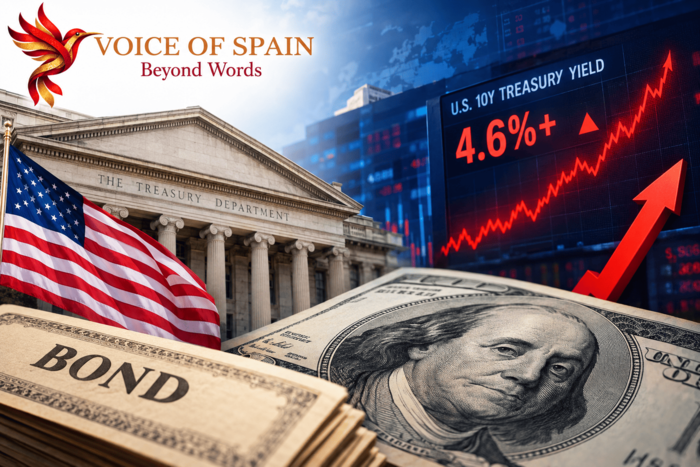
The global bond market has entered a period of heightened volatility as investors reassess inflation, government borrowing requirements and the future path of interest rates. The latest movement has been particularly significant in the United States, where the yield on the benchmark 10-year Treasury briefly climbed to 5.344 per cent, its highest level since 2002.
The rise in Treasury yields is important because US government bonds are widely regarded as a benchmark for borrowing costs across the international financial system. When Treasury yields rise sharply, the impact can extend beyond government debt markets, influencing mortgages, corporate borrowing, investment decisions, equity valuations and exchange rates.
The bond sell-off has also supported the US dollar. The dollar reached a 17-month high against the euro, continuing a period of strength that has been driven partly by the contrast between relatively strong demand for US assets and growing concerns about economic and fiscal conditions elsewhere.
The dollar index was heading towards its third consecutive weekly gain during the latest phase of the market movement. Investors have increasingly turned towards major reserve currencies and highly liquid assets as they attempt to navigate uncertainty surrounding inflation, government finances and geopolitical developments.
The euro, meanwhile, has faced considerable pressure. The European currency fell towards levels not seen since May 2025 as investors remained concerned about France's fiscal position and broader political and economic uncertainty in Europe. French government bond yields have also risen sharply, contributing to wider concerns about the sustainability of government finances.
One of the most important factors behind the bond-market pressure is inflation. Higher energy prices have added to concerns that inflation could remain elevated for longer than previously expected. Brent crude has also traded above $100 a barrel amid continuing geopolitical tensions and uncertainty surrounding energy supplies.
For central banks, this creates a difficult policy environment. Higher inflation normally increases pressure for tighter monetary policy, but aggressive rate increases can also weaken economic growth, raise borrowing costs and place additional pressure on households and businesses.
The US Federal Reserve therefore faces a complicated balancing act. Investors have been closely examining employment, inflation and wage data to determine whether another interest-rate increase could become necessary later in the year.
The latest bond-market movement has demonstrated that financial conditions can tighten even without an immediate change in official interest rates. Rising long-term Treasury yields increase the cost of financing throughout the economy and can affect companies, consumers and governments even when central-bank policy remains unchanged.
Another important issue is the growing level of government borrowing. Large fiscal deficits require governments to issue substantial quantities of debt. When investors demand higher compensation for holding that debt, yields rise, potentially creating a cycle in which governments face increasingly expensive financing.
The situation in Europe has added another layer of uncertainty. Concerns about France's fiscal outlook have contributed to higher French bond yields, while political uncertainty has made investors more cautious about European assets.
The effects are also being felt in foreign-exchange markets. A stronger dollar can make commodities priced in US dollars more expensive for buyers using other currencies. It can also increase the burden on countries and companies that have borrowed in dollars but generate revenue in weaker currencies.
Emerging markets can be particularly vulnerable to this environment. A stronger US dollar and higher US interest rates can encourage international investors to move money towards dollar-denominated assets, potentially putting pressure on emerging-market currencies and increasing their external financing costs.
For businesses, higher yields can also change investment calculations. Projects that appeared financially attractive when borrowing costs were low may become more expensive to finance when interest rates and bond yields rise.
For households, the consequences can eventually appear through mortgage rates, consumer credit and the cost of financing major purchases. Although the transmission varies from country to country, global bond-market movements can ultimately influence everyday economic conditions.
VoS STRATEGIC INSIGHT
The latest bond-market turmoil demonstrates that the global economy is entering a period in which inflation, government debt, energy prices and geopolitical risk are increasingly interconnected.
The US dollar's strength is not simply a reflection of American economic performance. It is also being supported by concerns elsewhere, particularly in Europe, as investors seek liquidity and relative safety during periods of market uncertainty.
The most important question for the months ahead will be whether inflation pressures remain strong enough to keep interest rates elevated or whether weaker economic activity eventually forces central banks to reconsider their approach.
For governments, the episode is also a warning about the cost of rising debt. For investors, it highlights the risks of assuming that the era of exceptionally low borrowing costs will quickly return.
Source: Reuters; The Jakarta Post; Business Recorder; global financial-market reporting.