VoS NEWS DESK | INTERNATIONAL | 16 OCTOBER 2026
Artificial intelligence is rapidly changing the global cybersecurity landscape. While financial institutions are adopting AI to improve fraud detection, customer services and transaction monitoring, cybercriminals are also using advanced technologies to develop more convincing scams, automate attacks and identify weaknesses in digital infrastructure. These developments have increased concerns among policymakers and financial regulators about the ability of existing security systems to respond to increasingly complex threats.
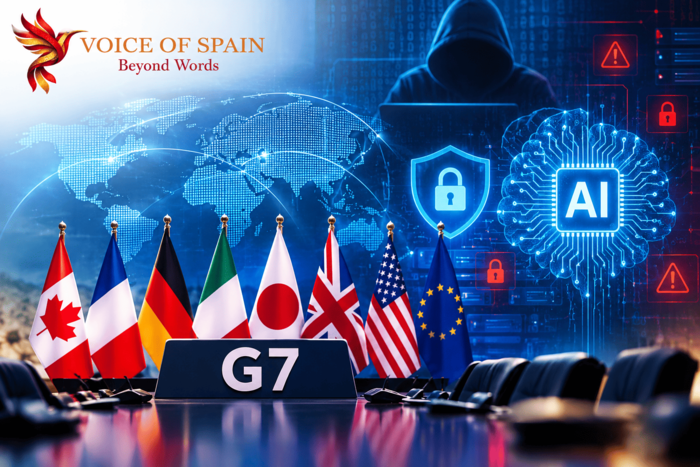
The G7 brings together Canada, France, Germany, Italy, Japan, the United Kingdom and the United States, alongside the European Union's participation in its work. Because these economies play a major role in global banking, international trade and financial markets, a serious cyberattack affecting one country's financial infrastructure could create consequences beyond its borders. Coordinated preparation is therefore essential to reducing the risk of widespread disruption.
The planned joint exercises are intended to help financial authorities assess how effectively they can respond when critical systems come under attack. Such simulations can recreate scenarios involving compromised banking networks, disrupted payment services, stolen financial information or interruptions to communication between financial institutions. By testing their response under controlled conditions, participating authorities can identify weaknesses before a real emergency occurs.
A key objective is to improve coordination between central banks, finance ministries, cybersecurity agencies, financial regulators and private-sector institutions. During a major cyber incident, the speed and accuracy of communication can be just as important as the technical response. Authorities need to establish how an attack will be reported, which institutions must be notified and how information can be shared without exposing sensitive customer or national-security data.
AI-powered cyberattacks present particular challenges because criminals can potentially use automated systems to conduct attacks at greater speed and scale. AI-generated messages may imitate legitimate business communications, while manipulated audio or video can be used to impersonate senior executives and persuade employees to approve fraudulent transactions. Financial institutions must therefore strengthen both their technical safeguards and their procedures for verifying sensitive instructions.
The G7's decision follows growing concern among international financial authorities that AI-related security failures could undermine public confidence in banks and payment systems. The International Monetary Fund has warned that an AI-enabled attack on a critical financial service could damage confidence in the wider financial system. Such risks make preparedness, rapid incident reporting and reliable recovery arrangements increasingly important.
Japanese Finance Minister Satsuki Katayama confirmed the agreement following a meeting of G7 finance ministers and central bank governors held alongside the IMF's annual gathering in Bangkok, Thailand. According to reporting by Reuters, the simulations will be developed by G7 financial authorities to test existing response procedures, with the findings expected to help revise operational manuals. Private financial institutions may also participate, depending on the scenarios selected.
Another important issue is the protection of cross-border financial transactions. Modern banking depends on interconnected systems that transfer money and information between countries within seconds. If a cyberattack disrupts one major institution, other banks, businesses and customers could experience delays or uncertainty. Joint exercises can help authorities understand how to coordinate emergency measures, maintain essential services and communicate accurate information during a crisis.
Financial institutions must also balance innovation with security. AI can help detect suspicious transactions, identify unusual network activity and support faster investigations. However, organisations need strong access controls, independent monitoring, secure backup systems and trained personnel to prevent automated tools from becoming an additional source of risk. Human oversight remains particularly important when AI systems are given access to sensitive information or financial operations.
The results of the proposed exercises could help participating authorities identify gaps in their current procedures and improve cooperation between countries. Their effectiveness, however, will depend on whether lessons learned during simulations are translated into practical improvements, regular testing and clear responsibilities for responding to real incidents.
VoS STRATEGIC INSIGHT
The G7 initiative highlights an important shift in global economic security: cybersecurity is no longer simply a technical concern for IT departments. It is also a matter of financial stability, public trust and international cooperation. As AI technology becomes more capable, financial authorities must prepare for attacks that may develop faster than conventional security procedures can handle.
The most effective response will combine international coordination, strong technical safeguards, staff training and reliable recovery plans. Regular simulations can expose weaknesses before criminals exploit them, but exercises alone cannot eliminate the threat. Banks and regulators will need to continually review their defences as AI technology and cybercriminal methods evolve.
For the wider global economy, protecting digital financial infrastructure is essential to maintaining confidence in payments, banking and international trade. The G7's planned exercises represent a practical step towards improving collective readiness, with the ultimate test being whether participating institutions can contain an attack, protect customers and restore essential services quickly.
Source: Reuters — G7 to launch exercises to guard against AI cyber attacks