VoS NEWS DESK | SCIENCE & TECHNOLOGY | 7 OCTOBER 2026
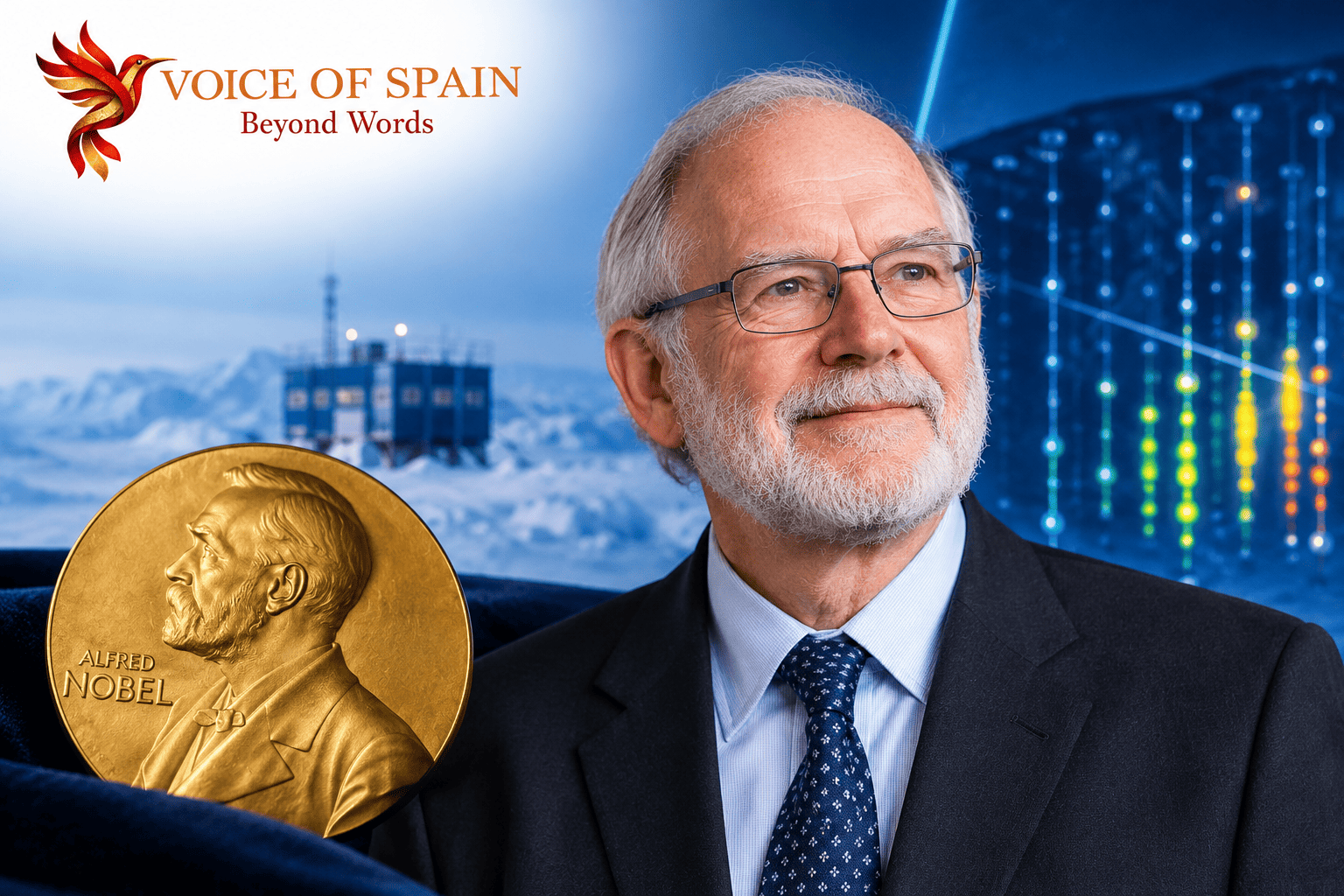
The 2026 Nobel Prize in Physics has been awarded to Francis Halzen, an 82-year-old Belgian-American particle physicist and professor at the University of Wisconsin–Madison, for his pioneering work on neutrinos and his central role in developing the IceCube Neutrino Observatory in Antarctica.
The Nobel committee recognised Halzen “for decisive contributions to the IceCube Neutrino Observatory and the discovery of high-energy neutrinos of astrophysical origin.” His work has helped scientists detect and study extremely energetic particles travelling across the universe from powerful cosmic environments.
Neutrinos are among the most elusive particles known to science. They have no electric charge and interact with matter extremely rarely, allowing enormous numbers of them to pass through the Earth and through human bodies almost completely undetected. Their unusual ability to travel vast cosmic distances makes them valuable messengers from some of the most energetic events in the universe.
Halzen's major scientific vision was to use the clear, ancient ice beneath the South Pole as a giant particle detector. When a high-energy neutrino occasionally interacts with an atomic nucleus in the ice, it can produce a small flash of light. Thousands of sensors embedded deep within the Antarctic ice can detect these flashes and help scientists determine where the neutrino came from.
This concept ultimately led to the creation of the IceCube Neutrino Observatory, an enormous detector embedded roughly 2,500 metres beneath the Antarctic surface. The facility covers approximately a cubic kilometre of ice and contains more than 5,000 light sensors designed to identify the extremely rare interactions produced by high-energy neutrinos.
IceCube has transformed neutrino research into a new form of astronomy. Instead of relying solely on visible light or other electromagnetic signals, scientists can use neutrinos as cosmic messengers to investigate distant and violent environments, including supernovae, black-hole activity and other high-energy astrophysical processes.
One of the most important achievements associated with Halzen's work was the detection of high-energy neutrinos originating from beyond our Solar System. These observations demonstrated that neutrinos could provide information about cosmic processes that may be difficult or impossible to study through conventional astronomical observations alone.
The scientific importance of the discovery extends beyond the identification of a new type of cosmic signal. Because neutrinos can travel through matter and across enormous distances without being significantly deflected or absorbed, they can preserve information about the environments in which they were produced. This gives researchers another way to investigate the origins of some of the universe's most powerful phenomena.
Halzen's achievement is also the result of a vast international scientific collaboration. More than 400 researchers from 14 countries have contributed to the IceCube project, demonstrating the scale of cooperation required to construct and operate one of the world's most ambitious scientific observatories.
Speaking after the announcement, Halzen described the Nobel recognition as a major surprise, saying he had not expected to receive the award. His research career has been closely associated with the development of neutrino astronomy and with the effort to turn an initially unconventional idea involving Antarctic ice into a functioning global scientific instrument.
The Nobel recognition comes as researchers are already looking towards the next generation of the project. The planned IceCube-Gen2 observatory is expected to be significantly larger than the existing detector, potentially providing scientists with an even greater ability to identify and study high-energy neutrinos from distant parts of the universe.
The award therefore represents more than recognition for a single discovery. It highlights the emergence of neutrino astronomy as a powerful new method of exploring the cosmos, allowing scientists to study the universe through particles that can cross enormous distances while carrying information about their origins.
VoS STRATEGIC INSIGHT
Francis Halzen's Nobel Prize highlights a major transformation in modern astronomy: scientists are increasingly studying the universe through multiple types of cosmic messengers, rather than relying only on light. Neutrinos offer a particularly valuable perspective because they can escape extremely dense and violent environments and travel across space with relatively little interference.
The success of IceCube also demonstrates how an unconventional scientific idea can become a major international research platform when combined with long-term investment, advanced engineering and global collaboration. As larger neutrino observatories are developed, researchers could gain new insights into black holes, stellar explosions, cosmic rays and the most energetic processes shaping the universe.
Halzen's work has consequently opened what the Nobel committee describes as a new kind of astronomy, with the potential to reveal cosmic phenomena that conventional telescopes cannot fully observe.
Source: Nobel Prize — 2026 Physics Prize | Reuters — Francis Halzen wins 2026 Nobel Physics Prize | Associated Press — Francis Halzen wins Nobel Prize in Physics