VoS NEWS DESK | EDUCACIÓN INTERNACIONAL | 7 OCTOBER 2026
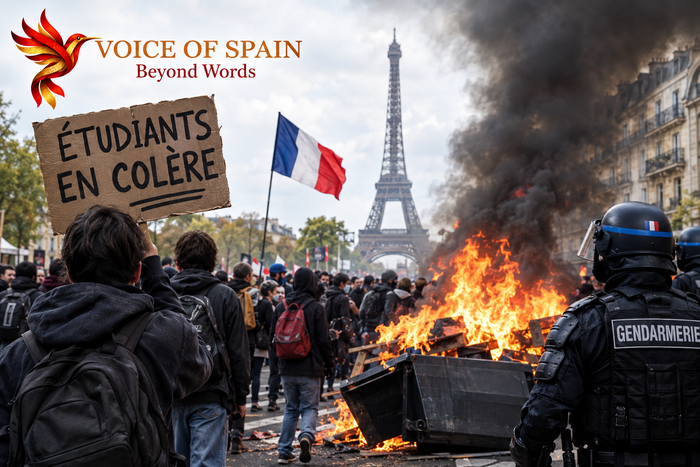
A nationwide wave of student demonstrations has brought education in France into the centre of a growing political confrontation. Thousands of schools have been affected by protests, blockades and walkouts, while clashes between demonstrators and riot police have resulted in arrests and injuries.
The movement initially emerged around complaints about deteriorating school infrastructure, overcrowded classrooms, teacher shortages and inadequate investment in secondary education. What began as protests in the Paris region gradually spread to cities across the country, becoming one of the most significant youth-led demonstrations France has experienced in years.
By early October, more than 1,000 secondary schools had been affected by strikes or demonstrations, including hundreds of blockades. Reports from French authorities and international media indicated that the scale of the movement had expanded considerably beyond the original demonstrations.
Students have described classrooms that are overcrowded, poorly maintained and sometimes unsuitable for learning. Among the complaints are teacher shortages, frequent staff absences, ageing buildings and inadequate facilities.
Some students have also criticised the length of the school day and the pressure associated with France's education system. Others have raised concerns about the country's higher-education application system and the difficulties young people face when attempting to secure places at universities and other institutions.
Climate conditions have added another dimension to the debate. Students have complained about classrooms becoming excessively hot during periods of high temperatures, arguing that education infrastructure needs to be adapted to a changing climate.
The protests have not remained entirely peaceful. Fires, property damage and confrontations with police have been reported in several cities. The French government has increasingly described some of the incidents as serious public-order disturbances rather than ordinary student demonstrations.
On 6 October, the protests reached another major moment, with more than 250,000 people taking part in demonstrations across France, according to reports. Paris alone saw tens of thousands of protesters. Riot police used tear gas during some confrontations, while hundreds of arrests were reported.
The government is facing pressure from several directions. Authorities must protect schools, teachers and students while also allowing peaceful protest and responding to the underlying concerns behind the movement.
Prime Minister Sébastien Lecornu has sought to address the crisis through dialogue, while the government has also defended the actions of security forces during violent incidents.
The protests have created a particularly difficult political situation because France is already dealing with wider economic and fiscal pressures. The government is attempting to control public spending while facing growing demands for additional investment in public services.
Education has therefore become part of a much wider argument about France's economic priorities.
Students and their supporters argue that reducing investment in schools could damage France's future workforce and deepen existing inequalities. Government officials, meanwhile, face the challenge of managing public finances while maintaining essential services.
The movement has also become increasingly political. Opposition parties have attempted to associate themselves with the protesters' concerns, while government figures have accused political groups on the far left of contributing to the escalation of unrest. Those accusations have been rejected by the parties concerned.
Another major concern is the number of young people affected by arrests and confrontations. Reports have indicated that a large proportion of those detained are minors, raising questions about policing methods, parental responsibility and the appropriate response to youth-led political activism.
The French authorities have defended the need to maintain public order, while human-rights organisations and opposition figures have raised concerns about excessive use of force in some incidents.
The crisis therefore goes beyond education. It has become a debate about the relationship between young people and the state, the future of public services and the ability of political institutions to respond to a generation increasingly frustrated with its economic and social prospects.
VoS STRATEGIC INSIGHT
France's student protests demonstrate how education policy can become a wider indicator of social confidence.
The original demands — more teachers, better facilities, manageable class sizes and improved learning conditions — are closely connected to questions about public investment and the future opportunities available to young people.
The government's response will be crucial. A purely security-focused response may contain individual incidents of violence but will not necessarily resolve the underlying educational grievances.
At the same time, peaceful protest can lose public support when schools are damaged, fires are started or police and civilians are injured.
The central challenge for France is therefore to separate legitimate educational demands from violence while creating a credible path towards improving school conditions.
For Europe more broadly, the French protests provide an important warning: young people's confidence in public institutions can deteriorate rapidly when they believe that their education, employment prospects and future living conditions are being compromised.
Source: Reuters; The Guardian; Associated Press; Euronews; Le Monde.