VoS NEWS DESK | INTERNATIONAL POLITICS | 10 September 2026
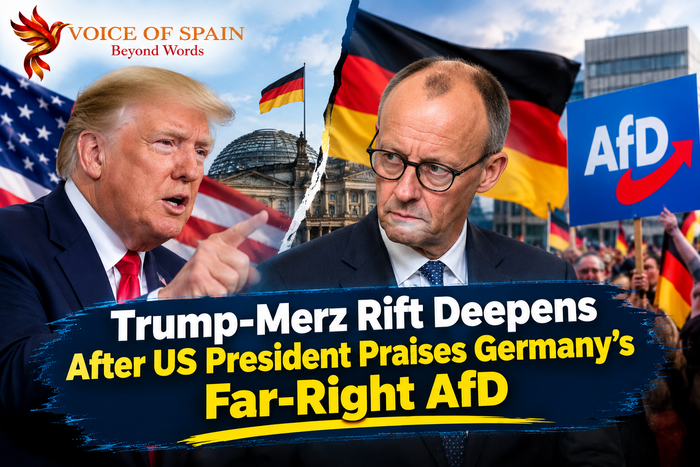
The dispute follows the AfD's historic performance in the Saxony-Anhalt state election, where the party secured around 44% of the vote. The result represented a major setback for Merz's governing coalition and marked the strongest electoral performance by a far-right party in Germany at state level since the Second World War.
Trump responded by congratulating the party's success on his Truth Social platform. He attributed the AfD's rise to what he described as Germany's “horrible” immigration rules and suggested that the party was gaining momentum. He ended his message with “MGGA”, widely interpreted as “Make Germany Great Again”, echoing his own political slogan.
The reaction in Berlin was sharply different. Merz's government has repeatedly opposed foreign political intervention in German elections and domestic politics. A German government spokesman confirmed that a planned telephone conversation between Merz and Trump had been postponed, while declining to give a direct reason. He indicated that the decision was not simply the result of a scheduling conflict.
The planned call was expected to focus partly on the 25th anniversary of the 11 September 2001 attacks in the United States. Its postponement has therefore attracted particular attention because it came immediately after Trump's comments celebrating the AfD's electoral success.
Tensions increased further in the German parliament, where Merz strongly criticised the AfD's policies on migration and its approach towards Russia. He argued that the party's advocacy of “remigration” would amount to what he described as ethnic cleansing if implemented according to its most extreme interpretation. The AfD rejected the accusation and said its policies were lawful.
The AfD's success is also creating difficulties for Merz domestically. The party has capitalised on public frustration over immigration, economic uncertainty, living costs and dissatisfaction with the federal government. Analysts say the result has increased pressure on Merz to demonstrate that his coalition can address voters' concerns while keeping Germany's mainstream parties united against the far right.
The disagreement also carries wider European significance. Germany remains one of Europe's most influential political and economic powers, while the United States is its key security partner within NATO. Open disagreement between Washington and Berlin over the treatment of a far-right German party could therefore complicate transatlantic relations at a time when Europe is already facing major security and economic challenges.
VoS STRATEGIC INSIGHT
The Trump-Merz dispute highlights a growing political divide across the Western alliance over immigration, nationalism and the role of far-right parties.
Trump's willingness to openly praise the AfD represents a significant departure from Germany's established political approach of isolating the party from mainstream government cooperation. Merz, meanwhile, is attempting to protect Germany's political centre while dealing with growing public dissatisfaction and pressure from the far right.
The immediate diplomatic dispute may eventually cool, but the underlying political differences are likely to remain. Germany's upcoming regional elections and the AfD's continued rise could make the relationship between Berlin and Washington an increasingly important issue for European politics.
Source: Reuters / Associated Press / The Guardian / German Government / VoS News Desk