VoS NEWS DESK | INTERNATIONAL | 2 September 2026
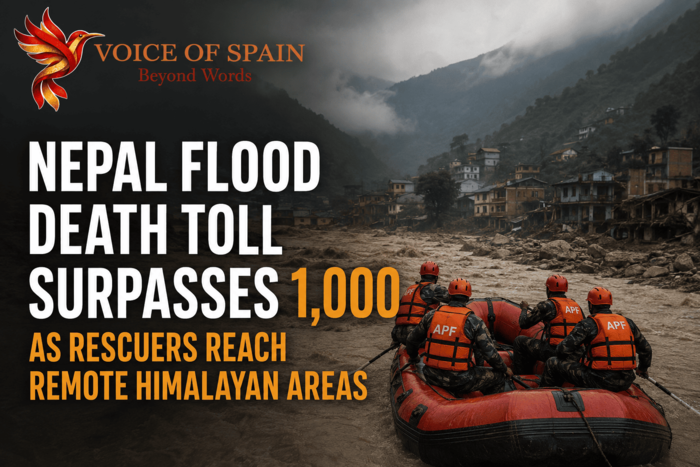
The scale of Nepal's Himalayan disaster has continued to grow, with the confirmed death toll rising above 1,050 people as emergency teams struggle to reach some of the most severely affected areas.
The disaster began on 26 August, when a massive glacier collapse and rock-and-ice slide triggered an enormous surge of water through valleys near Nepal's border with China.
The resulting flood swept through communities, destroyed homes and bridges, damaged roads and severely disrupted electricity and communications.
Authorities say around 3,916 people remain missing in Nepal, including hundreds of foreign nationals. China has separately reported deaths and missing people in Tibet following the same wider Himalayan disaster.
The disaster has left an estimated 2.2 million tonnes of debris across affected areas, creating enormous obstacles for rescue teams.
Helicopters have been deployed to reach communities cut off by destroyed roads and bridges, while excavators and heavy machinery are being used to clear mud, rocks and collapsed structures.
More than 11,000 people have already been rescued, according to the latest reports.
However, thousands of families remain desperately waiting for information about missing relatives.
One of the most difficult aspects of the rescue operation is the large number of people believed to be trapped at hydropower projects.
Around 900 workers are reported missing from affected hydropower facilities, with approximately 500 believed to be trapped inside tunnels.
Rescuers face extremely difficult conditions inside those tunnels.
Floodwater, mud and collapsed sections have blocked access, while damaged roads make it difficult to transport specialist equipment into the mountainous region.
The situation has created an urgent race against time.
Rescue specialists say people trapped underground may have limited access to clean water, food and breathable air.
Search teams are therefore working to clear entrances and establish whether survivors remain inside the damaged tunnels.
Foreign assistance has also become an important part of the response.
Teams and technical support have arrived from countries including China and India, while other international partners have offered equipment and humanitarian assistance.
International aid worth more than $42 million has begun flowing into Nepal as the country struggles to respond to the scale of the disaster.
The crisis has also affected Nepal's energy infrastructure.
Several hydropower facilities have been damaged, threatening electricity supplies and creating additional economic pressure for a country heavily dependent on hydropower.
Roads, bridges and communications networks have also suffered major damage, making it more difficult for emergency workers to move between affected communities.
In Kathmandu, authorities have begun burying unidentified victims in mass graves while attempting to preserve DNA and identification records so that families can eventually determine the fate of missing relatives.
The humanitarian consequences extend beyond the immediate death toll.
Thousands of survivors have been displaced, while many communities have lost homes, businesses, roads and essential services.
The destruction is expected to place enormous pressure on Nepal's already fragile economy.
The disaster has also renewed concerns about the vulnerability of the Himalayan region to climate change.
Scientists and climate experts have warned that rising temperatures are contributing to changes in glaciers and increasing the risk of dangerous glacial lake outburst floods and other forms of climate-related disaster.
Nepal's Prime Minister Balendra Shah has called for stronger international action on climate change following the disaster.
The government has also emphasised the need for improved monitoring and early-warning systems in vulnerable Himalayan areas.
The latest disaster demonstrates the difficulty of protecting communities living in remote mountain valleys.
Many settlements are located close to rivers and beneath steep slopes, while access to emergency services can be extremely difficult.
When a major glacial collapse occurs, there may be little time for residents to evacuate.
The disaster has therefore raised questions about whether existing warning systems are sufficient to protect communities as the Himalayan climate changes.
For Nepal, however, the immediate priority remains the rescue operation.
Emergency teams continue to search through destroyed villages, hydropower facilities and areas buried beneath mud and debris.
Families are still waiting for thousands of missing people to be located.
VoS INTERNATIONAL INSIGHT
Nepal's catastrophe is more than a devastating natural disaster. It is also a warning about the growing risks faced by communities living in the world's high mountain regions.
The Himalayas contain enormous quantities of ice and snow that provide water to millions of people.
But climate change is altering these systems, while rapidly changing glaciers can create dangerous conditions downstream.
The destruction caused by the latest flood shows how quickly a disaster in a remote mountain region can become a national humanitarian emergency.
For Nepal, the long-term challenge will be rebuilding damaged infrastructure while improving early-warning systems and disaster preparedness.
For the international community, the tragedy highlights the need for greater investment in climate monitoring, glacier research, emergency response and resilient infrastructure.
The rescue operation continues, but the recovery could take years.
Source: Reuters / Associated Press / The Guardian / UN-related reporting / VoS News Desk.