VoS NEWS DESK | INTERNATIONAL POLITICS | 13 September 2026
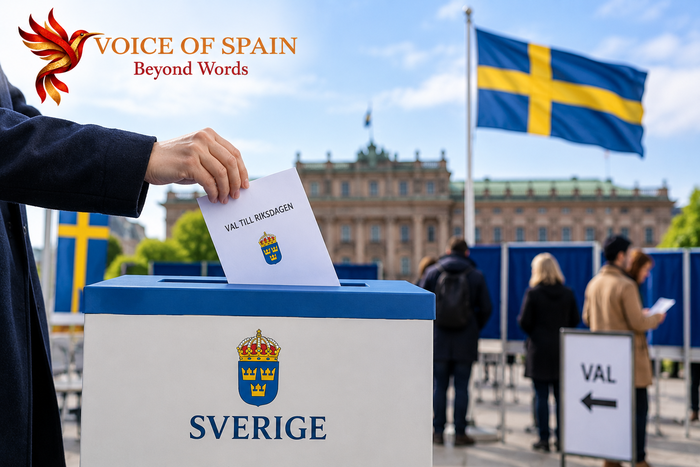
Millions of Swedish voters are casting ballots to elect all 349 members of the Riksdag, the country’s parliament. The result will determine the political balance of power and ultimately who can form Sweden’s next government. The contest has largely developed into a battle between the centre-left opposition led by former Prime Minister Magdalena Andersson and the centre-right governing bloc led by Prime Minister Ulf Kristersson.
The most closely watched element of the election is the growing influence of the Sweden Democrats, a populist right-wing party with far-right roots. The party has supported Kristersson’s government from outside the Cabinet since the previous election, but Kristersson has now indicated that the Sweden Democrats could receive ministerial positions if the right-wing bloc secures enough support to remain in power.
Such a development would represent a significant change in Swedish politics. The Sweden Democrats have already played an important role in shaping government policy, particularly on immigration, integration and crime, but bringing them formally into government would give the party direct responsibility for national policy and potentially transform Sweden’s political landscape.
The election campaign has taken place against the background of major changes in Sweden’s approach to immigration. Once regarded internationally as one of Europe’s more welcoming countries for migrants and refugees, Sweden has introduced increasingly restrictive policies in recent years. The current government has tightened asylum and citizenship rules and has also introduced financial incentives aimed at encouraging some foreign-born residents to leave the country.
Supporters of the government argue that the tougher approach has contributed to a substantial reduction in migration and improvements in public security. The government and its Sweden Democrat allies have also highlighted a decline in gang-related violence and shooting deaths as evidence that their tougher law-and-order policies are producing results.
However, critics argue that the increased influence of the Sweden Democrats has pushed Swedish politics further towards nationalism and has weakened the country's traditional liberal approach to immigration and social policy. Opposition parties have warned that allowing the far right to enter government could have long-term consequences for Sweden’s political culture and its approach to minority rights and integration.
The centre-left opposition, led by Magdalena Andersson and the Social Democrats, has remained ahead in many opinion polls, although its lead has narrowed considerably during the final phase of the campaign. Recent polling has suggested that the contest could be far closer than earlier forecasts indicated, creating uncertainty over which bloc will ultimately be able to assemble a workable government.
Andersson is seeking a return to the prime minister’s office after leaving government following the 2022 election. Her Social Democrats remain the largest party in the opposition camp, but forming a government could prove complicated because the centre-left parties do not always agree on taxation, energy, immigration and the role of the Centre and Left parties.
Coalition mathematics could therefore become just as important as the final vote totals. Even if one political bloc wins more seats than the other, disagreements between smaller parties could make it difficult to form a stable majority government. Sweden’s political system frequently requires parties to negotiate agreements and cooperate across ideological boundaries.
The Liberal Party is also attracting considerable attention because it must secure enough support to remain represented in parliament. Its performance could have a major impact on the balance between the two blocs and determine whether Kristersson’s coalition can retain a parliamentary majority or whether Sweden faces complicated post-election negotiations.
The election is taking place at a particularly important moment for Sweden internationally. The country joined NATO in 2024, ending more than two centuries of formal military non-alignment. Security and support for Ukraine remain important areas of broad agreement across the major political parties, meaning the election is expected to have significance beyond domestic politics.
Economic issues and public services have also played a major role in the campaign. Healthcare, education and law and order rank among voters’ leading concerns, while the economy, employment, taxation, climate policy and energy remain important issues. The election therefore goes beyond the question of immigration and the future role of the Sweden Democrats.
For Kristersson, the election represents an opportunity to secure another term and consolidate the political changes introduced by his government. His administration has increasingly relied on cooperation with the Sweden Democrats, and a second term could bring the two parties even closer together.
For Andersson, meanwhile, the election offers an opportunity to reverse that political direction. A centre-left victory could potentially restore a more traditional Social Democratic approach to government, although she would still face difficult negotiations with other opposition parties before being able to establish a stable administration.
The close nature of the contest means that even relatively small shifts in voter turnout or support for smaller parties could have a major impact on the final result. The political consequences could extend well beyond Stockholm, particularly if the Sweden Democrats become part of the Cabinet for the first time.
VoS STRATEGIC INSIGHT
Sweden’s election is significant because it reflects a wider political trend across Europe, where traditional centre-right and centre-left parties are increasingly being challenged by nationalist and populist movements. A formal entry of the Sweden Democrats into government would represent an important step in the normalisation of far-right political influence within a major European democracy.
The outcome will also provide an indication of how Swedish voters view the country’s tougher approach to immigration, crime and integration. If the right-wing bloc retains power and brings the Sweden Democrats into government, Sweden could move further towards restrictive migration policies and tougher law-and-order measures.
A centre-left victory, on the other hand, would demonstrate that voters remain receptive to a different political direction. However, the fragmented nature of Sweden’s parliament means that Andersson could face significant challenges in building a durable governing coalition.
For Europe, the Swedish result could therefore become another important indicator of the changing balance between mainstream parties and the populist right. The election is not simply about who becomes Sweden’s next prime minister; it could also determine how far the country’s political centre shifts over the next parliamentary term.
Source: Reuters • The Guardian • Associated Press — Sweden Election 2026