VoS NEWS DESK | SPORTS | 20 September 2026
The Indian team was initially approved with 492 athletes, but the number was later increased to 503 after the inclusion of four surfers, six track-and-field athletes and one mixed martial arts competitor. The expanded contingent reflects India's participation across a wide range of traditional and emerging sports.
The Asian Games officially opened in Nagoya on 19 September, with athletes from 45 countries participating in the event. Competitions are being staged across different venues in Aichi and Nagoya, with sporting events scheduled throughout the Games period.
India's contingent includes athletes competing in athletics, archery, shooting, boxing, wrestling, badminton, hockey, kabaddi, cricket, surfing, esports and other disciplines. The broad representation means Indian athletes will be competing throughout the Games rather than concentrating on a small number of sports.
The support structure accompanying the athletes is also substantial. The Indian delegation includes 246 coaches and support personnel, alongside 19 officials from the Indian Olympic Association, bringing the wider support group to 265 members. Their responsibilities include coaching, athlete preparation, logistics and administrative support during the competition.
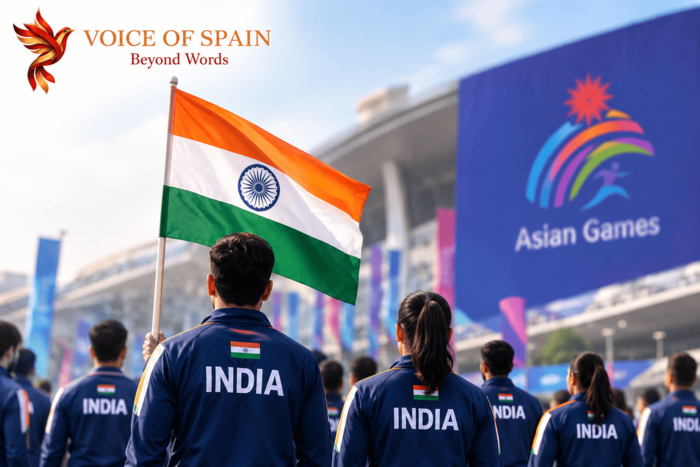
The opening ceremony also brought a last-minute change to India's flag-bearers. Shooter Manu Bhaker was originally named alongside shot-put athlete Tajinderpal Singh Toor, but Toor was subsequently replaced by kabaddi player Pawan Sehrawat. Reports said the change was linked to difficulties in getting Toor's ceremonial kit to Nagoya in time.
The change did not affect Toor's participation in the Games. He remains part of India's athletics team and is scheduled to compete in the shot put competition.
India enters the 2026 Games after a strong performance at the Hangzhou 2023 Asian Games, where the country won 107 medals, including 28 gold medals. The 2026 edition therefore provides another opportunity for Indian athletes to compete across a large range of disciplines and establish their individual and team results.
The size of India's current contingent is, however, smaller than the 661-athlete team sent to Hangzhou. Despite the smaller number, the 503 athletes cover 36 disciplines, including several sports in which India has established international competitors.
Several Indian athletes are also competing in events where the country has previously won Asian Games medals. Cricket is among the sports in which India enters the competition as the defending champion in both the men's and women's tournaments.
For many younger members of the contingent, the Games also represent an important international competition experience. Their results will depend on individual events, qualifying rounds, team fixtures and knockout stages, meaning India's overall performance will develop throughout the two-week competition.
With events spread across multiple venues, the Indian contingent's schedule will continue well beyond the opening ceremony. Medal events will take place at different stages of the Games, while some disciplines will only reach their decisive rounds towards the closing days.
VoS STRATEGIC INSIGHT
India's participation in the Aichi-Nagoya Asian Games is built around a 503-athlete contingent covering 36 disciplines, with 269 men and 234 women. A substantial coaching and support structure has also travelled with the athletes.
The opening ceremony also highlighted the scale and changing nature of India's participation, with Manu Bhaker and Pawan Sehrawat leading the contingent after a last-minute change to the flag-bearer arrangement.
India's final sporting performance cannot be assessed from the opening stage alone. Results will become clearer as individual competitions, team events and medal rounds are completed across the Games.
Source: The Indian Express; Business Standard; NDTV Profit.