VoS NEWS DESK | EUROPE | 30 August 2026
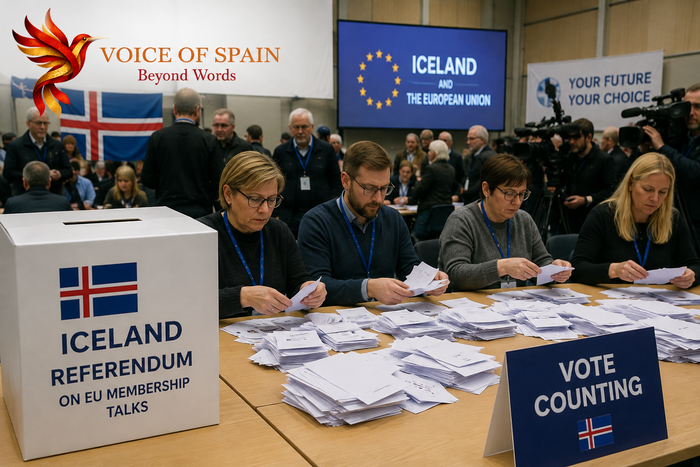
Iceland has begun counting votes after voters took part in a closely contested referendum that could determine whether the country reopens negotiations with the European Union.
Preliminary results showed the “no” camp narrowly ahead, with around 50.1% opposing the reopening of membership talks and 49.9% supporting the proposal based on approximately 152,000 votes counted. A final result was expected as the remaining ballots were processed.
The referendum does not decide whether Iceland will actually become an EU member. Instead, voters are deciding whether the government should reopen negotiations with Brussels.
If voters approve the proposal, Iceland could begin accession discussions later in 2026. Any eventual agreement would still have to go through further political and public approval before membership could become a reality.
The vote represents a major moment in Iceland's long-running debate over its relationship with the European Union. The country originally applied for EU membership in 2009, but negotiations were suspended and ultimately abandoned in 2013 under a Eurosceptic government.
Economic considerations have played an important role in the latest debate. Iceland has faced high interest rates and concerns over living costs, encouraging some voters and political groups to reconsider whether closer integration with the EU could provide greater economic stability.
Supporters of reopening negotiations argue that EU membership could give Iceland greater influence over decisions affecting the European single market, while potentially strengthening economic ties and providing a pathway towards adopting the euro.
Iceland is already closely connected to Europe through the European Economic Area, Schengen area and European Free Trade Association, meaning the country enjoys many benefits of European economic and travel integration without being an EU member.
However, opponents remain concerned about national sovereignty and the potential impact of EU membership on Iceland's control over its natural resources.
The country's fishing industry is particularly sensitive to the debate. Fishing remains strategically and economically important to Iceland, and concerns over European rules governing fisheries have become one of the strongest arguments against membership.
Geopolitical developments have also influenced the discussion. Iceland occupies a strategically important position in the North Atlantic, and growing tensions between Russia and Western countries have renewed attention on European security cooperation.
The debate has therefore moved beyond economics and trade. Supporters increasingly view closer European integration as a potential way of strengthening Iceland's political and security position at a time of heightened geopolitical uncertainty.
The government has said it will respect the outcome of the referendum. Prime Minister Kristrún Frostadóttir has presented the vote as an important decision about Iceland's future relationship with Europe.
The narrow preliminary margin demonstrates just how divided Icelandic society remains. Recent opinion polls had also shown the electorate moving between support and opposition in the days leading up to the referendum, reflecting the uncertainty surrounding the issue.
If negotiations are reopened, the process could take considerable time. Iceland would have to negotiate the terms of any possible accession before citizens could ultimately be asked to approve actual membership.
The result will therefore not immediately change Iceland's relationship with the EU. Instead, it could determine whether the country enters a new phase of negotiations after more than a decade away from the accession process.
For the European Union, the vote is also significant. A renewed Icelandic application would come at a time when the bloc is dealing with major geopolitical challenges and reassessing its wider role in European security and economic policy.
VoS STRATEGIC INSIGHT
Iceland's referendum reflects a broader European debate about sovereignty, economic security and geopolitical alignment.
A decision to reopen EU negotiations would not guarantee membership, but it would represent a significant change in Iceland's foreign and economic policy after years of keeping the accession process frozen.
The country's strategic position in the North Atlantic makes the decision particularly important. At a time of heightened security concerns across Europe, closer integration could offer Iceland greater political influence within European institutions.
However, the debate over fisheries, sovereignty and national decision-making means that any future accession process would remain politically sensitive.
The narrow preliminary result also demonstrates that Iceland's European future is far from settled. Whatever the final outcome, the referendum is likely to keep EU membership at the centre of Icelandic political debate for years to come.
Source: Reuters / VoS News Desk