VoS NEWS DESK | INTERNATIONAL | 23 August 2026
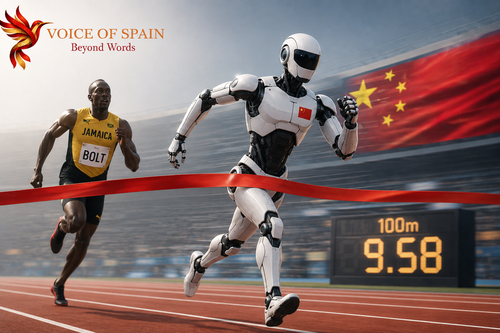
A Chinese humanoid robot has surpassed the men's 100-metre world record set by Jamaican sprinting legend Usain Bolt, completing the distance in 9.39 seconds during the World Humanoid Robot Games in Beijing. Bolt's human record of 9.58 seconds has stood since 2009.
The robot, named Tiangong Ultra and developed by the Beijing Humanoid Robot Innovation Center, achieved the remarkable time during a preliminary heat at the competition. It narrowly defeated another Chinese humanoid robot, Honor's Lightning, which completed the race in 9.47 seconds. Both performances were faster than Bolt's official human record.
The results demonstrate how quickly humanoid robots have improved. Tiangong Ultra completed the same 100-metre event in 21.50 seconds during last year's competition, meaning its latest performance represents a dramatic improvement in only one year.
The achievement is particularly significant because humanoid robotics is becoming one of China's major technology priorities. Companies and research institutions are investing heavily in artificial intelligence, advanced motors, sensors, batteries and robotic control systems in an effort to develop machines capable of operating in human environments.
The World Humanoid Robot Games have been designed to demonstrate these capabilities through competitions based on human sporting events. More than 2,000 robots are participating in the latest edition, with competitions covering athletics, football and other physical challenges.
However, the impressive sprint times also reveal some of the limitations of current humanoid technology. Robots capable of reaching extraordinary speeds can still struggle to stop or maintain their balance. During the race, Tiangong Ultra stumbled into the sidelines after crossing the finish line, while Lightning also experienced a dramatic fall.
Another striking performance at the games involved the standing high jump. A humanoid robot reached 2.88 metres, exceeding the previous human high-jump world record of 2.45 metres set by Cuba's Javier Sotomayor in 1993.
The competition therefore serves two purposes: demonstrating what robots can already accomplish while also exposing the engineering challenges that remain. Speed alone does not make a robot capable of functioning effectively in a factory, hospital, warehouse or home.
Developers must still solve complex problems involving energy efficiency, stability, navigation, dexterity and autonomous decision-making. A robot that can sprint extremely quickly in a controlled environment may behave very differently when required to interact safely with unpredictable surroundings.
China's progress nevertheless places additional pressure on technology companies and governments elsewhere. The United States, Europe, Japan and South Korea are also investing heavily in humanoid robotics, making the sector an increasingly important area of global technological competition.
The latest performance also demonstrates how artificial intelligence is increasingly being combined with advanced physical machinery. As AI systems become more capable of interpreting environments and making decisions, humanoid robots could eventually perform increasingly complex physical tasks.
VoS STRATEGIC INSIGHT
The record-breaking performance represents more than an unusual sporting achievement. It demonstrates the rapid convergence of artificial intelligence, robotics and advanced engineering, while highlighting China's growing ambitions in one of the world's most closely watched emerging technology sectors.
The most important development may not be that a robot has beaten a human sprint record, but how dramatically robotic performance has improved within a single year. Such progress suggests that humanoid machines could become increasingly capable of performing practical tasks outside controlled laboratories and competitions.
At the same time, the dramatic falls at the finish line underline the gap between impressive demonstrations and reliable real-world autonomy. The next major challenge for robotics will be turning extraordinary individual performances into machines that are safe, adaptable, efficient and genuinely useful in everyday environments.
Source: Reuters / AP / VoS News Desk